

Topline
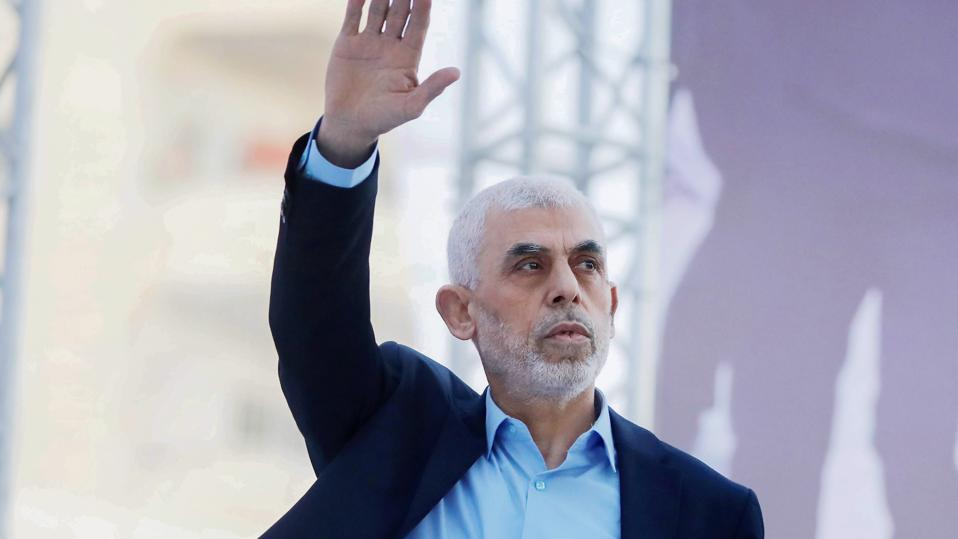
The Israel Defense Forces said this week they are closing in on the home of one of their biggest targets, Yahya Sinwar, the former Israeli prisoner and leader of the Gaza-based militant group Hamas referred to by Israeli officials as a “dead man walking.”
Key Facts
Sinwar, who Israeli officials have called the mastermind of Hamas’ Oct. 7 attack on Israel, grew up in southern Gaza and joined Hamas—an Islamist group founded in 1987—in the late 1980s, gaining recognition as the founder of the group’s intelligence arm, the Munazzamat al Jihad w’al-Dawa, also known as the Majd.
In 1989, Sinwar was sentenced to four consecutive life sentences for abducting and murdering two Israeli soldiers, and served in an Israeli prison—reportedly learning Hebrew there—until his 2011 release, part of a massive prisoner swap in which Israeli officials freed more than 1,000 prisoners in exchange for Israeli soldier Gilad Shalit, who had been captured by Hamas.
Since his release from prison, Sinwar has been involved in multiple rounds of fighting against Israel, including an 11-day crisis in May 2021, when Hamas and the Palestinian Islamic Jihad launched rockets at Israel and Israel conducted airstrikes in Gaza.
In 2015, the U.S. State Department designated Sinwar a global terrorist, prohibiting U.S. citizens from engaging in transactions with Sinwar—he has also been sanctioned by the U.K. and France.
Sinwar, 61, was elected Hamas’ Gaza leader in 2017 in a secret election, offering a public platform of “peaceful, popular resistance” despite a reputation as a hardliner, and was reelected to a second four-year term in 2021, months before another round of Hamas rocket attacks on Israel.
Sinwar has also gained prominence as a critic of Mahmoud Abbas, the head of the Palestinian Authority and its ruling Fatah party—a rival to Hamas that controls the West Bank but not Gaza—with Sinwar vowing in a rally marking Hamas’ 35th anniversary last year to “give the chance to ignite the resistance in the West Bank.”
Sinwar vowed in that speech to come for Israel “God willing, in a roaring flood” and “with endless rockets” and “millions of our people, like the repeating tide,” according to a translation by Reuters.
While Israeli officials have cited Sinwar as the force behind Hamas’ Oct. 7 attack, Harel Chorev, a senior researcher of Middle Eastern studies at Tel Aviv University, told CNN this week Sinwar was one of a “triumvirate” of senior Hamas officials who planned the attack on Israel.
Chorev also told CNN Sinwar is “perceived as the most senior” Hamas official, though Chorev said Sinwar is only one of several “power centers” within Hamas, which Chorev said maintains a “decentralized” organizational structure, with some senior leaders living in Qatar.
Sinwar has in the past publicly expressed caution over warring with Israel, telling Italian journalist Francesca Borri in 2018 a “new war is in no one’s interest,” adding Hamas would be open to negotiating with Israel in exchange for Israel and Egypt lifting their blockade of Gaza (that blockade has been in place since Hamas took control of Gaza in 2007).
Key Background
Fighting resumed in the Gaza Strip late last week, after a string of temporary cease-fires expired. Facing mounting calls from western leaders for a pause in the fighting, Israel and Hamas reached an agreement on an initial four-day cease-fire late last month, with Hamas vowing to release some of the hostages captured in its Oct. 7 attack and Israel agreeing to release roughly 150 Palestinians held in Israeli prisons. Israel and Hamas extended the pause in the fighting for two more days contingent on more hostages being released, though that pause came to a sudden stop last week, when the IDF accused Hamas of violating the cease-fire and resumed its aerial bombardment on the Gaza Strip—Hamas released just over 100 hostages. In recent days, the fighting has centered around the Hamas stronghold Khan Younis in southern Gaza, after Israel’s initial invasion focused on Gaza City in the enclave’s north. On Wednesday, Israeli Prime Minister Benjamin Netanyahu said in a tweet that the IDF had surrounded Sinwar’s house in Khan Younis, though the move is believed to be largely symbolic, as the Hamas leader is believed to be hiding deep underground in Hamas’ extensive labyrinth of tunnels. In his tweet, Netanyahu acknowledged Sinwar’s house “is not his castle, and he can flee, but it is only a matter of time until we find him.”
Big Number
More than 18,200. That’s how many people are estimated to have been killed in the fighting since Hamas launched its attack on Israel on Oct. 7, leading to Israel declaring war. That death toll includes more than 17,000 people in Gaza, according to the Hamas-led Gaza Health Ministry, as well as approximately 1,200 people killed in Israel during Hamas’ Oct. 7 attack, according to Israeli officials.
Tangent
Israel said Wednesday it has killed roughly half of Hamas’ mid-level commanders in Gaza, though it has not killed members of Hamas’ leadership, including Sinwar and Mohammed Deif, the head of Hamas’ al-Qassam Brigades, the Wall Street Journal reported.
Further Reading
Israel And Hamas Reach Hostage Release Deal In Exchange For 4-Day Pause In Fighting (Forbes)