

My wife never understood my Nick Cave infatuation. The despair, the murder ballads, the gothic graveyard nature of it all; even with Cave’s soulful baritone and lyrics that rise to actual poetry, the dark prince of alt rock never landed well with the bubblier one in our marriage. “Any chance you could play some less depressing music?” Ruth would say if “People Ain’t No Good” or “The Mercy Seat” ever slipped by.
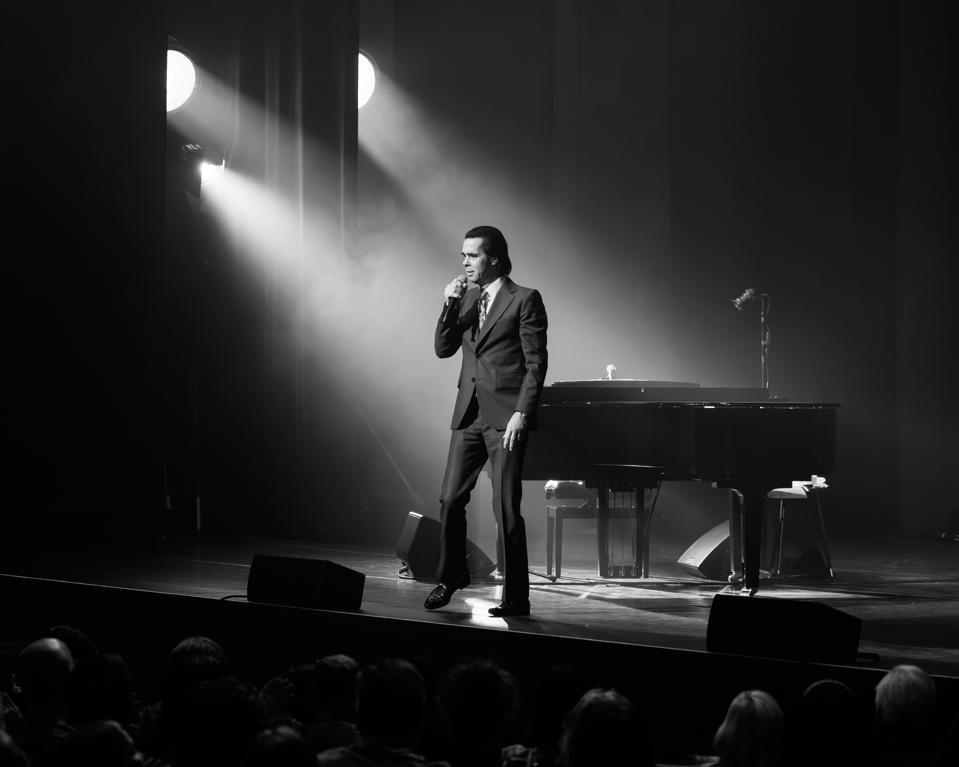
The four times I’ve seen Cave perform live in Los Angeles, I brought along the moodiest, brooding-est non-married-to-me I know. And they loved it. We loved it. (You could tell by how we nodded solemnly afterwards and said, “Yeah, that was good.”) Whether it was a raucous full-on rock spectacle at The Forum or an intimate audience Q&A with Cave on piano at Disney Concert Hall, the experiences had a deeper resonance than probably any other shows I’d seen.
But even as I quietly concealed my Cave habits for years—listening mostly on solo drives or watching documentaries like 20,000 Days on Earth and This Much I Know to Be True only when Ruth was out—I sensed that my wife was missing something, not only in the music and in the vibe, but with me. This was my heart music. I’m not the first to say that seeing Cave live can be a quasi-religious experience in how he brings people together (people who dress like vampires, especially). But it’s true. If you can sit with the darkness with Cave, the light comes in. Or as another poet once put it, the way up is the way down.
I’ll admit I was slightly nervous this past weekend bringing Ruth to the Orpheum Theatre in Los Angeles for the last of a three-night stand in L.A. that capped Cave’s North American tour. I also laugh a little as we walked in. Most of the guys looked like me, in demeanor and age and dress. Black on black on black was both the uniform and temperament of choice. Ruth put her arm in mine and whispered, “Your people.”
But then came Cave, and I could tell immediately that Ruth was hooked. Alone at the grand piano with only Radiohead guitarist Colin Greenwood accompanying him on bass guitar, this was a stripped-down, inside-out version of The Man I Tried So Hard to Hide. He called it an exploration of songs, a prodding, a questioning—and Ruth and I both got it as Cave went all in on songs he recorded with his band The Bad Seeds and collaborator Warren Ellis. “O, Children.” “Papa Won’t Leave You, Henry.”” “Jubilee Street.” “The Weeping Song.” Yes, the music was ponderous, even bleak on occasion, like the night’s opener, “Girl in Amber,” from the album Skeleton Tree:
If you want to bleed, just bleed
If you want to bleed, just bleed
If you want to bleed, don’t breathe
But Cave’s spirit and magnetism turned it all around. What you miss when only hear Cave’s studio music is his wit and dare I say buoyant charisma. Take “Balcony Man,” a song from his latest album, Carnage, about how “what doesn’t kill you makes you crazier.” It’s a weighty ballad about, well, I’m not sure what, but he made the song fun by asking the balcony audience to scream their lungs out every time Cave sang that word in the title. Balcony. Ahhhhhhh!
Ruth loved it all, and I loved that she did. But how could she not, right? Cave has lived so deeply – two of his sons died in recent years, and Cave has been a model of openheartedness in writing about and processing this grief. He is here to show you the survival is possible and that it’s okay. All of it. Death, politics, pain, regret, rainy days, even differences in musical opinion with your beloved. Ruth found it all intoxicating. She found him surprisingly sexy, fascinatingly complex.
Okay, so it took a while, but I might be able to come out of hiding after all.