

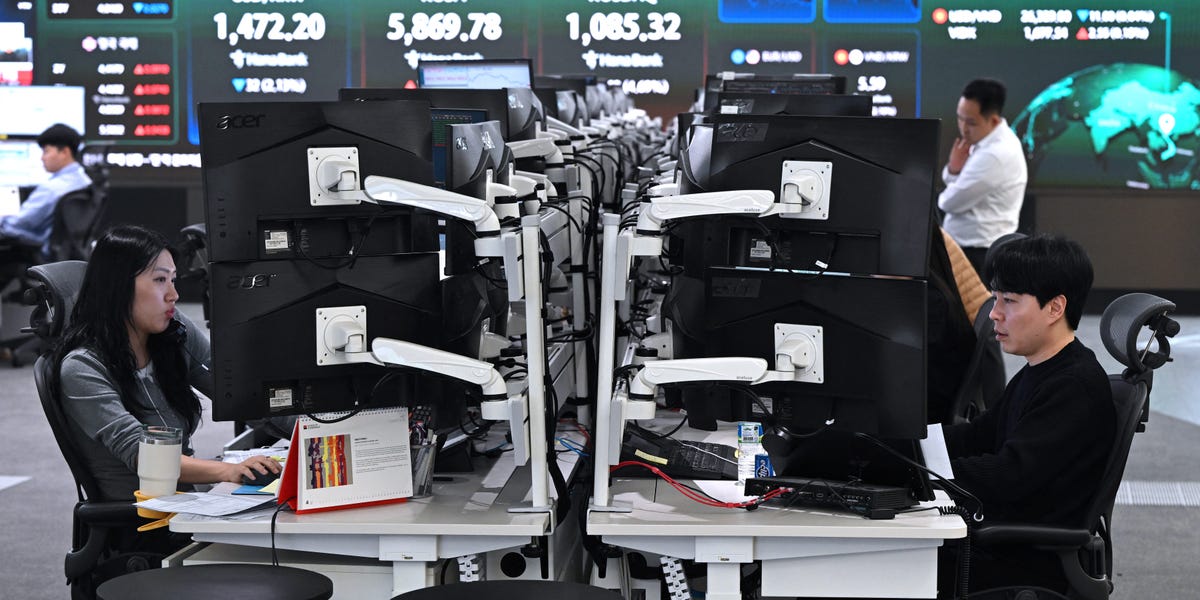
South Korea’s stock market dropped sharply on Tuesday as investors uncovered fresh grounds for apprehension regarding the AI trade. The benchmark Kospi index plummeted over 7% intraday to its lowest point since July 31, prolonging a dramatic reversal for what was once the world’s most dynamic AI-powered stock market.
AI chip leaders Samsung Electronics and SK Hynix spearheaded the decline, slipping 9% and 10% respectively by midday. The weakness permeated across Asia, with Japan’s Nikkei and Taiwan’s chip-heavy Taiex both dropping approximately 3%.
The downturn followed another lackluster session for US semiconductor stocks overnight, including Micron. Investors are evaluating an expanding array of concerns about the AI trade, ranging from intensifying Chinese competition to uncertainties surrounding how the industry’s massive infrastructure expansion will be funded.
“The most recent catalyst has been further evidence of China’s rising ambitions throughout the AI ecosystem,” Chris Weston, the head of research at Pepperstone, wrote in a note Tuesday.
Weston highlighted Chinese memory-chip manufacturer CXMT, which stated it had made advancements in developing technology that could store more data on memory chips and that it intends to unveil a new server-memory product by year-end.
CXMT has not yet demonstrated its ability to manufacture the technology at scale, and the announcement does not immediately challenge South Korea’s dominance in high-bandwidth memory chips used in AI accelerators. However, it has intensified investor concerns about how long memory producers can sustain their pricing power.
Want more Themoneytimes in your news feed? Add Themoneytimes in Google so our reporting is easier to find when you’re searching for what matters.
This selloff represents another setback for the Kospi, which was the top-performing major stock index globally in the first half of 2026 before tumbling in the second half as investors pivoted to other segments of the AI hardware supply chain, including Taiwan.
Adding to these concerns, Broadcom CEO Hock Tan cautioned on Monday that capital, rather than chips or electricity, could emerge as the biggest constraint on the AI industry’s growth. Collectively, these developments indicate investors are looking beyond AI demand alone.
They are also examining pricing power and margins. China’s capability to produce increasingly competitive technology at lower costs is “undermining established assumptions around market share, pricing power and the endurance of margins,” Weston wrote.