

As states across the US join the patchwork legal battle against prediction markets, California — one of the country’s last and largest holdouts against legal sports gambling — has mostly stayed on the sidelines.
That’s no guarantee that it will stay that way forever, according to the state’s top law enforcement official.
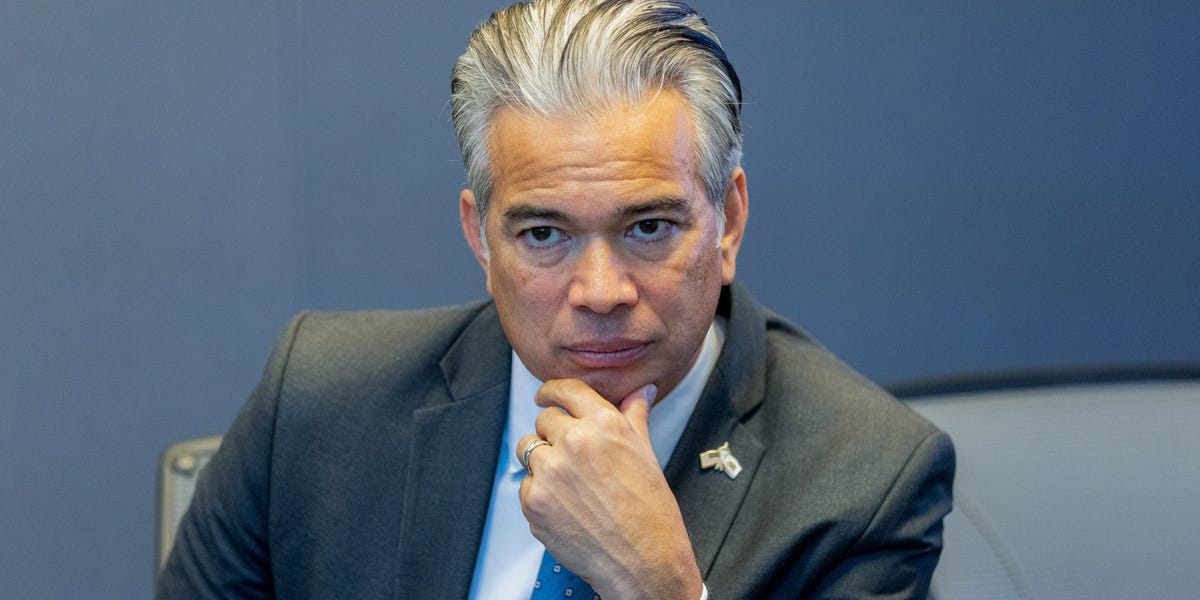
“We are very protective of our sovereignty,” Attorney General Rob Bonta told Business Insider on Tuesday.
Bonta said his office has been “firmly engaged” on prediction markets and “firmly disagrees” with the view that the US Commodity Futures Trading Commission’s oversight of prediction markets pre-empts states’ ability to regulate them.
“I think each state will determine what they want to do, what they think is appropriate, what kind of risk they want to take, what kind of resources they want to deploy,” he said.
“The fact that we haven’t sued, I think you should not read too much into it,” he added.
Bonta also said he had been in touch with Evan Corder, his former chief of staff, who is now a lobbyist for Kalshi and other regulated prediction markets.
“He has chosen clients that I don’t necessarily see eye-to-eye with, but I will have a conversation with anyone about anything if they want to discuss it,” Bonta told Business Insider. “And sometimes it makes more firm my disagreement, but I think we need to be open to conversation.”
Bonta didn’t say what they talked about or when they spoke, and a member of his staff didn’t respond to follow-up questions. Corder declined to comment.
Over the past year, Kalshi and other companies, like Crypto.com and Polymarket’s US affiliate, have given people in all 50 states the chance to bet on sports through “event contracts” that they say are only subject to federal regulation.
Bonta noted that prediction markets are new and said that courts are still mulling the limits of what they can do.
He pointed to an opinion his office issued last summer that said daily fantasy sports, like those offered by PrizePicks and Underdog, are illegal in California.
Corder has also represented Underdog, according to his website.
In California, legal gambling is mostly limited to Native American casinos, like those run by the Pechanga Band of Indians and the San Manuel Nation.
Politico reported in October that tribal interests have been major contributors to Bonta’s campaigns, and that Victor Rocha, a tribal gaming official, claimed that his request spurred the opinion that resulted in the daily fantasy sports opinion.
California tribes have also sued over the growth of prediction markets into areas that have traditionally been seen as gambling. Last summer, Rocha was quoted as referring to Kalshi CEO Tarek Mansour as a “lying little twerp.”
Rocha said he and others in the tribal-gaming industry don’t understand why Bonta hasn’t taken bigger steps against prediction markets. But he said he sees Bonta as “very cautious” and doesn’t fault him for hearing from a Kalshi representative.
“We feel that he is an ally, and we’re all in the same direction,” he told Business Insider, noting that Bonta’s office issued regulations that limit the offerings of so-called cardrooms that have competed with casinos.
Kalshi declined to comment.
Have a tip? Know more? Reach Jack Newsham via email (jnewsham@businessinsider.com) or via Signal (+1-314-971-1627). Use a personal email address, a nonwork device, and nonwork WiFi; here’s our guide to sharing information securely.