

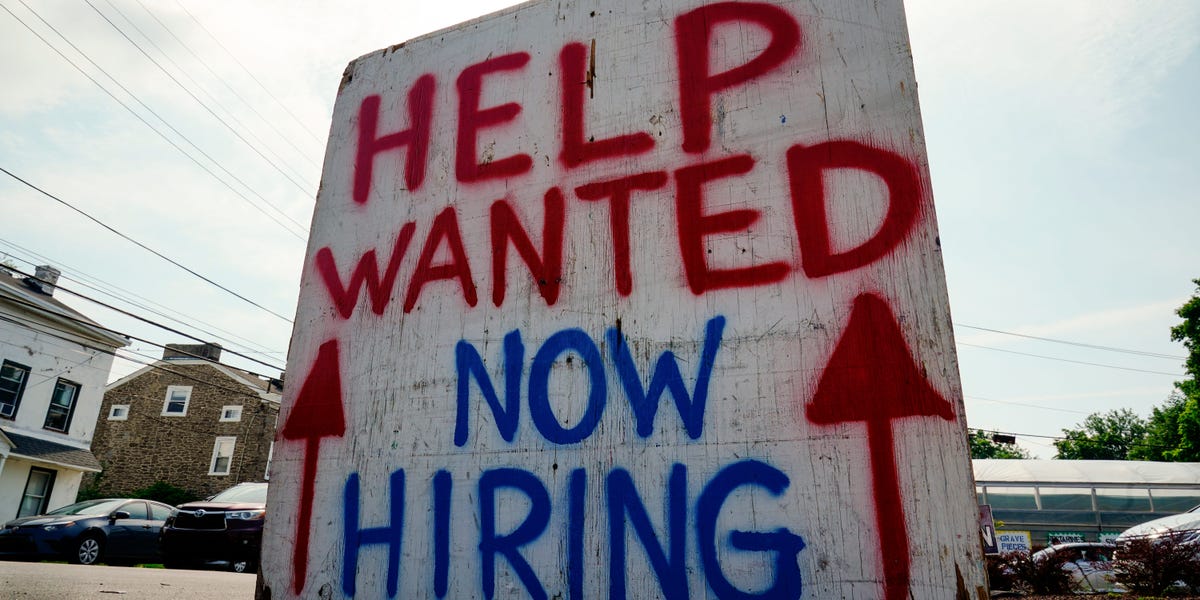
It’s jobs Friday, and we’re about to learn if the labor market’s “deep freeze” continued to thaw in February.
Economists expect the US added 55,000 jobs and the unemployment rate held steady at a fairly low 4.3%. Last month’s report showed a surprisingly strong job gain in January, but revisions to last year’s data meant 2025 as a whole saw the weakest growth outside a recession in over 20 years.
We’ll be watching to see if the job market keeps heating up, or if January’s strength was just a blip.
Check here for updates as we gear up for the report at 8:30 ET, when we’ll break down all the details you need to know.
Job switching may be paying off again
The wage premium for job switchers widened in January after collapsing for a majority of 2024 and 2025. That’s based on data from the Federal Reserve Bank of Atlanta’s wage growth tracker.
Nicole Bachaud, an economist at ZipRecruiter, said overall year-over-year wage growth outpacing inflation signals that workers still have some bargaining power.
February is expected to be cooler than January’s job growth
While another good month of job growth could signal a more bullish job market in 2026, don’t be too alarmed if the headline number comes in soft. A snowy February and a roughly monthlong Kaiser Permanente strike will probably be reflected in the numbers.
“Severe winter weather likely weighed on hiring in weather‑sensitive industries, including construction, leisure and hospitality, retail, and transportation,” EY economists Gregory Daco and Lydia Boussour said.
While another good month of job growth could signal a more bullish job market in 2026, don’t be too alarmed if the headline number comes in soft. A snowy February and a roughly monthlong Kaiser Permanente strike will probably be reflected in the numbers.
“Severe winter weather likely weighed on hiring in weather‑sensitive industries, including construction, leisure and hospitality, retail, and transportation,” EY economists Gregory Daco and Lydia Boussour said.
“In addition, healthcare employment growth likely softened after January’s outsized gains, reflecting both payback from prior strength and a notable drag from labor disruptions with roughly 31,000 healthcare workers on strike during the payroll survey period.”
The next Fed meeting is coming up in a week and a half
Today’s jobs report and next week’s dual inflation reports will help the Federal Reserve make its next interest rate decision. Federal Open Market Committee members will meet for the second time this year on March 17 and 18. Ahead of the jobs report, CME FedWatch, which shows market-based probabilities of the meeting’s outcome, showed a near-100% chance of a rate hold.
The Fed decided to hold rates steady in its first decision of 2026 in January. “Having lowered our policy rate by 75 basis points over the course of our previous three meetings, we see the current stance of monetary policy as appropriate to promote progress toward both our maximum-employment and 2% inflation goals,” Federal Reserve chair Jerome Powell said.
The economy is still growing, even though jobs are stagnant
The economy grew 2.2% last year, a slower pace than recent years but still showing some strength, while the US recorded the lowest job growth outside a recession in over two decades.
“This is an unusual job market, and so you would expect something to break,” Laura Ullrich, the director of economic research in North America at the Indeed Hiring Lab, said, which could mean either a pickup in hiring or layoffs.
The economy grew 2.2% last year, a slower pace than recent years but still showing some strength, while the US recorded the lowest job growth outside a recession in over two decades.
“This is an unusual job market, and so you would expect something to break,” Laura Ullrich, the director of economic research in North America at the Indeed Hiring Lab, said, which could mean either a pickup in hiring or layoffs.
“Consumers are feeling the weight of the price increases, and combined with the jobs outlook that’s worsening they say, ‘OK, when I look out, I don’t see prices going down that much, but I do see my wage is not growing and my job not being as reliable or secure as it once was,'” Atsi Sheth, the chief credit officer at Moody’s Ratings, told Business Insider.
Is AI behind layoffs?
Block CEO Jack Dorsey announced around the end of February that the fintech company was laying off more than 4,000 of its over 10,000 workers. Dorsey said it wasn’t because “we’re in trouble,” but intelligence tools combined with “smaller and flatter teams” are enabling a shift.
Stephanie Aliaga, global market strategist on the JPMorgan Asset Management Market Insights Team, questioned in a December post whether we’re at the start of AI-driven job losses or if this technology is “simply the new label for conventional belt-tightening.”
Block CEO Jack Dorsey announced around the end of February that the fintech company was laying off more than 4,000 of its over 10,000 workers. Dorsey said it wasn’t because “we’re in trouble,” but intelligence tools combined with “smaller and flatter teams” are enabling a shift.
Stephanie Aliaga, global market strategist on the JPMorgan Asset Management Market Insights Team, questioned in a December post whether we’re at the start of AI-driven job losses or if this technology is “simply the new label for conventional belt-tightening.”
“The emerging evidence points more to the latter,” Aliaga said. “AI is touching the labor market, but so far, its impact is selective and uneven, changing how people work rather than whether they work at all.”
Some employees use AI to automate tasks like crafting emails, and some solo founders have found uses for it while working on their own.
“Over time, we can expect automation, AI and further process simplification to reshape how work gets done — some roles will change, new ones will emerge and others will no longer be required,” said Jane Fraser, CEO of Citi, in a January memo.
Are white-collar fields still growing?
Employment in the information sector, which includes telecommunications, publishing industries, and more, has generally been cooling. There were 2.8 million people working in this sector in January, 9% below the November 2022 peak.
Employment in financial activities was down from a year ago as of January. Employment in professional and business services has been on the rise over the past few months, but was just short of where it stood a year ago in January.
Employment in the information sector, which includes telecommunications, publishing industries, and more, has generally been cooling. There were 2.8 million people working in this sector in January, 9% below the November 2022 peak.
Employment in financial activities was down from a year ago as of January. Employment in professional and business services has been on the rise over the past few months, but was just short of where it stood a year ago in January.
White-collar sectors aren’t the only areas where it’s hard to find a job opportunity. Employment in manufacturing, as well as in mining and logging, has dropped over the last couple of years.
One sector is doing especially well amid the frozen job market
Gregory Daco, the chief economist at EY, described the job market as in a “deep freeze.” Hires, quits, and job openings are all a lot lower than they were a few years ago, signaling a labor force that isn’t moving around a whole lot.
However, the private healthcare and social assistance sector is still thriving in the low-hire, low-fire state. Employment in this sector increased by 18% from January 2019, far surpassing the 4% growth in all other nonfarm payrolls. It’s expected to keep growing as the population ages.
Gregory Daco, the chief economist at EY, described the job market as in a “deep freeze.” Hires, quits, and job openings are all a lot lower than they were a few years ago, signaling a labor force that isn’t moving around a whole lot.
However, the private healthcare and social assistance sector is still thriving in the low-hire, low-fire state. Employment in this sector increased by 18% from January 2019, far surpassing the 4% growth in all other nonfarm payrolls. It’s expected to keep growing as the population ages.
“Healthcare is definitely a job-producing engine that will continue to be so,” Christian Gomez, a vice president at ADP, said.
Overall, private education and health services added 137,000 jobs this past January.
“It’s almost like Groundhog Day,” Laura Ullrich, the director of economic research in North America at the Indeed Hiring Lab, told Business Insider. “Each month, it’s like whether the jobs report is a little stronger or a little weaker, the strength we are seeing is coming from that one sector.”
Markets end a bumpy week dominated by Iran
At the end of a week in which market narratives have been dominated by the war in Iran and the sharp spike in oil prices it triggered, futures are pointing to a small drop in US stocks on Friday.
As of just after 6 a.m. ET, the Dow Jones, S&P 500, and the Nasdaq all look set to open between 0.2% and 0.5% lower on the day. The Dow is set to shed around 110 points at the open, adding to the precipitous drop of nearly 800 points it saw during a painful session on Thursday.
At the end of a week in which market narratives have been dominated by the war in Iran and the sharp spike in oil prices it triggered, futures are pointing to a small drop in US stocks on Friday.
As of just after 6 a.m. ET, the Dow Jones, S&P 500, and the Nasdaq all look set to open between 0.2% and 0.5% lower on the day. The Dow is set to shed around 110 points at the open, adding to the precipitous drop of nearly 800 points it saw during a painful session on Thursday.
With the index heavily weighted to industrials, a 7% jump in oil prices on the day was the catalyst for the Dow’s heavy losses on Thursday.
Elsewhere in markets on Friday, oil has pushed higher once again, with West Texas Intermediate up 3.7%, or $3 per barrel, to $84. Brent, the international benchmark, is 1.8% higher at $87 per barrel.
Stocks in Europe are somewhat becalmed, with both the UK’s FTSE 100 benchmark and Germany’s DAX almost entirely flat.
What we learned from the last jobs report
The US beat job growth expectations, adding 130,000 jobs in January, with the healthcare sector accounting for almost two-thirds of that. The report also unveiled revised data for 2025; it turns out the economy only added 181,000 jobs, way softer than the 584,000 previously reported.
That marks the lowest annual job growth since 2003, outside the deep recessions following the 2008 financial crisis and 2020 COVID-19 pandemic.
The US beat job growth expectations, adding 130,000 jobs in January, with the healthcare sector accounting for almost two-thirds of that. The report also unveiled revised data for 2025; it turns out the economy only added 181,000 jobs, way softer than the 584,000 previously reported.
That marks the lowest annual job growth since 2003, outside the deep recessions following the 2008 financial crisis and 2020 COVID-19 pandemic.
Meanwhile, the unemployment rate ticked down in January from 4.4% to 4.3%.