

China makes 70% of the world’s drones. Blake Resnick wants to change that. Backed by Sam Altman and Peter Thiel, the Brinc founder is on his way to making his quadcopters the top choice for America’s cops—if only he can get the federal government to ban his primary competitor.
A frantic woman makes a 911 call in the suburban town of Queen Creek, Arizona, southeast of Phoenix, claiming her boyfriend is trying to strangle her. After officers arrive on scene, the suspect slips away.
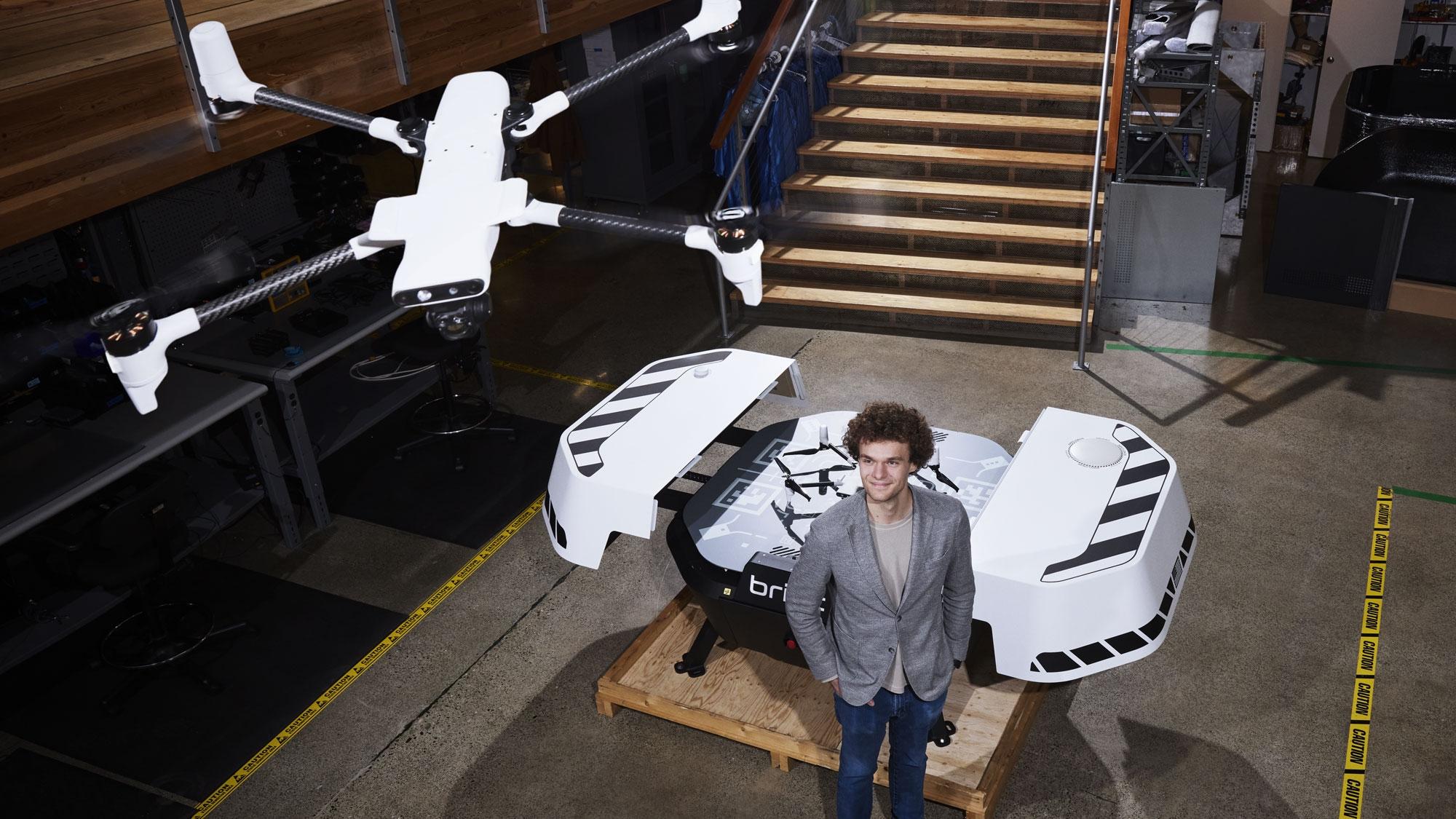
They launch a Brinc “Responder” drone, which locates him about four minutes later near a major roadway. When the cops catch up, he says he’s armed and ready to shoot. The drone’s camera zooms in. He’s lying. There’s no gun in sight. The officers safely approach and arrest him. The drone flies back to its “nest”—a five-by-five-foot charging dock on the police department’s roof with white metal doors that snap shut like a mechanical Venus flytrap.
Drones scoping out the scene of a crime is an increasingly common scenario in American policing. What is far less common is that they’re made in America. DJI, the giant Chinese drone maker, controls 70% of the global market for government and commercial drones, per analyst estimates, worth some $18.6 billion in 2024. Over 80% of public safety organizations with a drone fleet use DJI devices (while only 7% use Brinc’s).
But crucially for Brinc and its 25-year-old founder, Blake Resnick, the Responder is made in Seattle, not Shenzhen. Resnick’s bet is that American police will soon be using American drones—whether by choice or by necessity. As of December 23, unless the NSA or another security agency vouches for DJI, its drones will be banned from future sale in the U.S.—much to the chagrin of cops and first responders who tell Forbes the Chinese manufacturer’s devices are cheaper, more reliable and more technically advanced. One of DJI’s most advanced police drones, the Matrice M30T, costs around $15,000; Brinc’s comparable Responder starts at $20,000. Even Resnick admits, “DJI makes incredible products at very low prices.”
Where there’s a national security concern, though, there’s a business opportunity. Brinc and Resnick have ridden the wave of America First–ism to a $480 million valuation after raising $157 million in funding from Motorola, London-based Index Ventures and billionaires including Sam Altman, Peter Thiel and Figma cofounder Dylan Field.
Resnick isn’t coy about his position in the geopolitical tussle. “I don’t think it’s healthy that the free world controls less than 5% of the global drone market,” he says from his office at Brinc headquarters in Seattle, which overlooks lines of engineers in blue coats assembling Responder charging nests. “The end stage here is that we’re the DJI of the West.”
A framed copy of the sanctions Beijing imposed on the company, and on him personally, hangs in his office. Last December, the Chinese banned Brinc and Resnick (along with a dozen other companies) from conducting business with or traveling to China. Plus, Resnick had a hand in the impending DJI ban. Over the last three years, he spent $660,000 on lobbying, including for controls over the use of Chinese-made drones in the U.S. That’s a huge amount of money for a deeply unprofitable company that booked just $5 million in sales last year, per Forbes estimates (and is on track for $15 million this year). But the payoff is potentially huge. Should the ban go ahead, “there will be an enormous amount of demand for us,” says Resnick, whose estimated 40% share in Brinc is now worth $192 million.
China hawks in Congress fear DJI’s tools could be used to send sensitive information on Americans back to Beijing, though the company has long labeled that unfounded hearsay. Adam Welsh, head of global policy at DJI, said, “The U.S. government has every right to strengthen national security measures, but this must go hand in hand with due process, fairness and transparency.” À la TikTok, the company is now asking the U.S. government to start a review of its tech or grant an extension. (The Federal Communications Commission did not respond to repeated requests for comment.)
While it’s not a top-of-the-line DJI, the Responder, which launched last year, is no clunker. From their nests, the drones can reach an emergency within a two-mile radius in 70 seconds or less. A Responder, which is largely controlled remotely by officers, can fly up to 42 minutes on a full battery and needs just 35 minutes to recharge. Even with a population of less than 90,000, Queen Creek has kept its single Responder drone busy. Since it became one of America’s first police departments to try the drone in June, its Responder has been sent on more than 450 missions: burglaries, sexual assaults, suicides and shots fired. The Responder was first on the scene 131 times and handled 35 situations without an officer present, for things like automatic (often false) car crash reports.
Chief Randy Brice says he plans to purchase an entire fleet. The department’s older drones—primarily made by DJI, of course—are starting to collect dust. “We wanted to find an American-made item that wouldn’t be hit by any type of prohibition,” he says.
Along with the Responder, which is made specifically for 911 calls, Brinc also offers the Lemur (starting price: $10,000), designed for indoor use by SWAT teams, and the Brinc Ball, a $2,500-and-up softball-sized communications device that can be thrown into scenarios in which making direct contact or delivering a cellphone is too difficult—think hostage situations or natural disasters.
So far, Brinc has attracted more than 700 customers, mostly police departments, about 100 of which bought a Responder. Buyers range from small to medium-sized agencies such as the Pueblo PD in Colorado to the largest police agency in the U.S., the New York Police Department. At the federal level, Immigration and Customs Enforcement (ICE) is a user.
Brinc’s origins date to October 2017. A 17-year-old Resnick was at his childhood home in Las Vegas when a mass shooting occurred just 20 minutes away. A gunman had opened fire from his 32nd-floor hotel room on the Vegas Strip, targeting attendees of the Route 91 Harvest Festival. Fifty-eight people were killed; more than 400 were wounded. Resnick, who had built drones since he was 10 years old, wondered why the cops didn’t use one in a situation like this. He bombarded the police department with requests for a meeting.
Over coffee at a local Einstein Bros. Bagels, Lieutenant Will Huddler of the Las Vegas Metro Police Department listened skeptically as the gangly six-foot-three teenager with a mop of frizzy brown hair insisted he could build a drone that was unlike any consumer drone out there, one with features specific to SWAT teams. Huddler decided to give the kid a chance: 90 days to build a prototype.
Resnick went to work, piecing together components, mostly made in China, on his parents’ dining table. On day 86, he demoed the device to 40 SWAT members. No good. One officer swiftly slapped it out of the air with a towel, proof enough that it wasn’t ready for the real world.
But Resnick didn’t give up. Drones were an obsession—his latest after years of taking apart toys, then hair dryers, then microwaves. An early diagnosis of dyslexia worked in his favor when he was enrolled in extra classes: He skipped sixth grade, spent a year and a half in high school and then headed to the University of Las Vegas at 14. Internships at McLaren and Tesla followed, then a transfer to Northwestern, where he studied mechanical engineering. He took a few months off to intern at DJI in Palo Alto, California, and saw firsthand how the global leader built flying machines. He never went back to school, dropping out in early 2017 to try his hand at making drones himself.
Three months after his humbling experience with the Vegas team, Resnick called back, this time with a drone that could right itself. Huddler, impressed, invited him to join the SWAT team for some ride-alongs, where he remembers squeezing “a tactical helmet over that beautiful head of hair.” Together, Resnick and the Vegas SWAT team developed the Lemur, which would become his flagship drone. Brinc—short for Blake Resnick Inc.—officially incorporated in 2018 with Vegas Metro as its first customer.
For two years, Brinc was a one-man operation. Then Resnick received $100,000 from the Thiel Fellowship, which gives entrepreneurial kids funds to skip college. Revenue hit $100,000 a year, but if Brinc was going to scale, Resnick needed more capital. His savior came in the form of Sam Altman, the OpenAI CEO who was then a ravenous tech investor. In 2020, Resnick joined a call with a friend of a friend who was looking for investment opportunities. The acquaintance, who Zoomed in shirtless and in bed, stopped Resnick mid-pitch to say he wasn’t going to invest but would make introductions, including to a former romantic partner of Altman’s. Shortly after, Altman emailed Resnick directly, asking about revenue, customers, use cases, growth rate and how much he planned to raise. Resnick replied in a heartbeat. “OK, I’d like to invest,” Altman responded some 36 hours later. A $2 million check followed. Altman then brought in Scale AI’s billionaire founder, Alexandr Wang, for another $150,000. “It really changed my life,” Resnick says. “That gave me much-needed capital and credibility, which I used to get our first headquarters and make our first hires.”
It also opened the door to his next, much larger funding rounds, with Wang making the introduction to blue-chip firm Index, which led Brinc’s $25 million Series A in 2021, as well as its most recent $75 million round in April. Thiel invested a small amount in 2022, the same year Resnick made the Forbes 30 Under 30. “He’s a sponge,” says Index partner Vlad Loktev. “Realizing that there’s still a lot to learn is very important, especially when someone starts a company so young.”
In his 22,000-square-foot Seattle facility, where Brinc moved in 2021, Resnick forcefully shoves an airborne Lemur drone, pushing it to the ground in an echo of the Vegas PD’s original test. It buzzes loudly, like a giant mechanical bee, as it rights itself and returns to eye level. On a handheld controller, there’s a live feed from the drone’s camera. Resnick dials a number into his phone, connecting directly to the Lemur thanks to one of Brinc’s partnerships with AT&T, T-Mobile and Verizon. For his next trick, he shows how the Lemur can quickly shatter windows using a tip made of an extremely hard material that combines tungsten and carbon—scattering glass shards across the parking lot outside.
Resnick spends little time in HQ these days. He travels three days a week, pitching police chiefs and mayors on the Responder. Huddler sometimes goes too: Now retired from the Vegas PD, he’s Brinc’s VP of customer success, training other cops to use its drones. Resnick estimates around 15% of SWAT teams in the U.S. currently use the Lemur, making it far and away Brinc’s most successful product.
Some, though, don’t believe Brinc’s devices compare to DJI’s at all, especially when tested in more extreme environments. Kyle Nordfors of Utah’s Mountain Rescue Association flies drones on SWAT missions and above the Rockies when climbers find themselves in peril. He says Brinc devices aren’t reliable, nimble or quick enough to reach people in “life or death” scenarios: “DJI devices are just better in every way.”
Cops have had similar quibbles. “Range is definitely an issue,” says Luis Figueiredo, a police drone pilot from New Jersey who has flown the Lemur. The glass-breaking tool, he adds, “doesn’t always work as intended.”
Even if DJI ends up banned, Brinc is up against a major American competitor: San Mateo, California–based Skydio, which has raised over $730 million from VCs including Andreessen Horowitz and has more than 1,000 public safety customers. ICE has spent $1.4 million on Skydio drones since 2021, compared to just $80,000 on Brinc machines. The NYPD has 41 Skydio devices and 40 DJI drones in its fleet, and only six of Brinc’s.
There’s another clear market opportunity for Brinc: defense. After Russia invaded Ukraine in 2022, the company sent 60 Lemurs to Kyiv to assist in search-and- rescue missions. But besides some exploratory meetings with Defense Department officials, Resnick didn’t pursue any Pentagon contracts. Still, Brinc’s work in Ukraine has helped it understand how to make devices that work when radio frequencies and GPS are constantly jammed.
Brinc’s time in warfare may come, though. “I care about democracy existing,” Resnick says. And if the U.S. were ever to go to war with China, it would be like those days after the music festival shooting: Resnick wouldn’t be able to sit out the mission.