

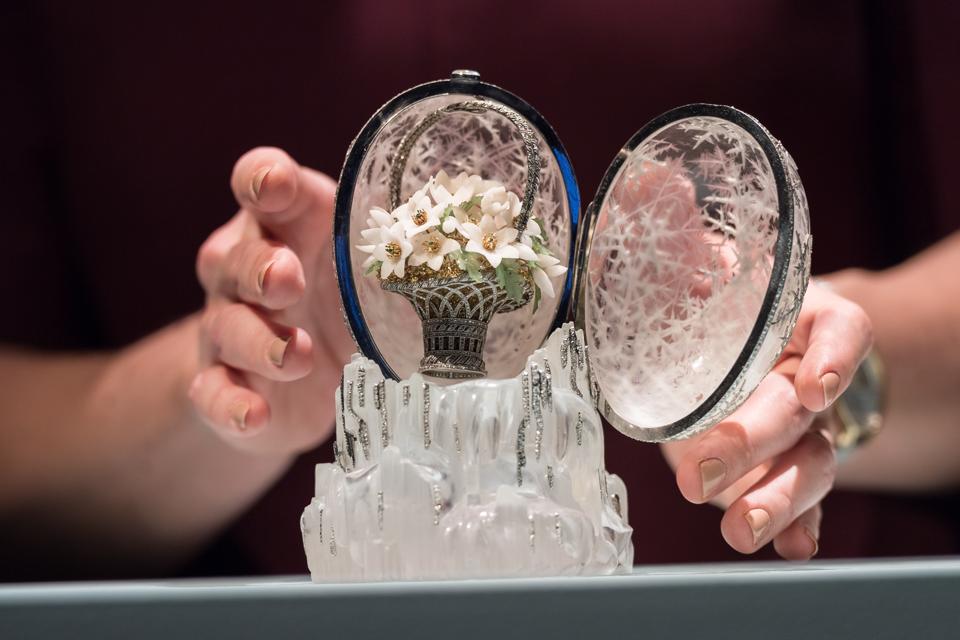
The frosty cold Fabergé Winter Egg was red hot when it appeared at auction Tuesday, fetching nearly 22.9 million pounds ($30.2 million), smashing the previous record for a Fabergé egg at Christie’s London.
Bidding started at 17 million pounds and quickly rose to 19 million pounds where it paused, as viewed through a reply of the sale through Instagram. It sold soon after for the hammer price of 19.5 million pounds ($25.7 million), not including commissions and fees, to a person in Christie’s saleroom.
The final price of $30.2 million smashed the previous record price for the Rothschild Egg sold at Christie’s London in 2007 for 8.9 million pounds ($11.7 million in today’s dollars and about $17.5 million 2007).
The Imperial Winter Egg was commissioned by Emperor Nicholas II from Fabergé as a gift for his mother, the Dowager Empress Maria Feodorovna, on Easter Day, 1913. The gift of a Fabergé egg was a Romanov family tradition, inaugurated by Emperor Alexander III. He presented one to his wife—the same Maria Feodorovna—every year from 1885 on. Nicholas II continued the custom after he came to the throne, in 1894, and extended it by giving an egg to his wife, Empress Alexandra, as well as to his widowed mother.
The finely carved rock crystal egg is engraved on the interior with a frost design. Rose-cut diamond-set platinum snowflake motifs are applied on its exterior. It is further decorated with two vertical diamond-set platinum borders concealing a hinge on the side. This is surmounted by a cabochon moonstone dated “1913” on a rock-crystal base formed as a block of melting ice, applied with rose-cut diamond-set platinum rivulets, centering a platinum pin in the middle to support the egg.
The egg opens to reveal the “surprise” suspended from a platinum hook: a double-handled trelliswork platinum basket, set throughout with rose-cut diamonds. It’s filled with finely carved white quartz wood anemones, each flower with gold wire stem and stamens. The center is set with a demantoid garnet. The leaves are carved in nephrite, appearing to emerge from a bed of gold moss. The base of the basket is engraved “FABERGÉ 1913”.
The egg is adorned with more than 4,000 diamonds. Christie’s says it is “among the most lavish and artistically inventive of the 50 Imperial eggs made by the House of Fabergé” made specifically for the Russian royal family. Fabergé made a total of 69 bejeweled Easter eggs between 1883 and 1917. The eggs that were not considered Imperial Eggs were made for the aristocracy and the industrial and financial elite.
The Imperial Winter Egg was designed by Alma Theresia Pihl-Klee, one of the two female designers at Fabergé and one of the best-known female Fabergé workmasters. The workmaster for the bejeweled object was Albert Holmström, who was Fabergé’s head jeweler.
The egg was the top item in the 48-lot auction, “Christie’s The Winter Egg and Important Works by Fabergé from a Princely Collection.”
According to Christie’s research, Nicholas II was not consulted during the design and creation, as he liked to be surprised. He never knew what he was paying for until the eggs were brought to him during Holy Week.