

“Life always triumphs, and art and spirit are our engines,” Koyo Kouoh, then executive director and chief curator of Zeitz Museum of Contemporary Art Africa, told a friend of mine before her untimely passing at only 57. I returned to this quote, shared in correspondence, as I sit down to relive a year in art. Whether directly or indirectly responding to our fractious world, the exhibitions I’ve witnessed this year—from my base in London to other parts of Europe and beyond—have been questioning, strikingly lyrical, and at times explosively confrontational. Work that helps navigate the cold, dark winter months ahead.
From Kerry James Marshall’s powerful paintings that redefined the possibilities for Black artists working on their own terms, to Peter Doig’s melodic interweaving of memory and place, Wayne McGregor’s embodied enquiries, William Kentridge’s insistence on maintaining “provisional coherence” in his fascinatingly layered body of work, and Arthur Jafa’s urgent, political, uncompromising work, 2025 has been a year that shows arts and ideas can help shape tomorrow’s world.
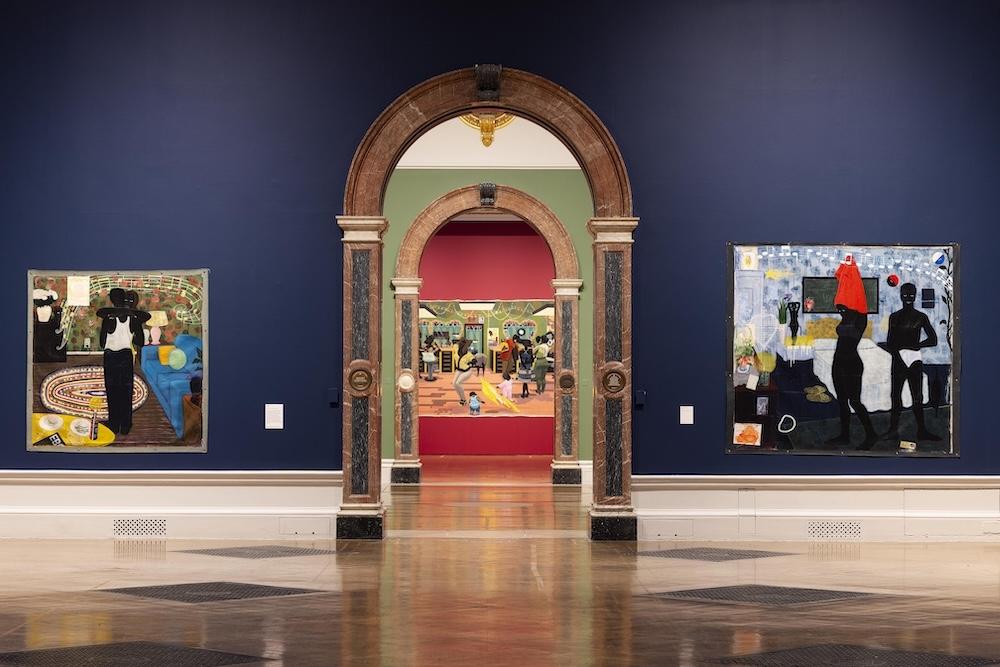
Essential viewing in London is Kerry James Marshall’s “The Histories” at the Royal Academy (until January 18, 2026). The American artist is one of the most influential contemporary history painters working today—an artist who fundamentally shifted what was possible, creating space for Black artists to make work without explanation, without needing white institutional validation. His monumental paintings, elegantly installed hall after hall at the RA, refuse justification. They simply exist, depicting Black life with all its complexity, dignity, humour, and claiming an unapologetic presence in the art historical canon. Marshall hasn’t simply made space for Black representation; he has redefined the terms entirely.
More quietly powerful was the retrospective of the late Noah Davis at the Barbican earlier this year. Gathering over fifty works by the Los Angeles artist who died in 2015 at just 32, the exhibition filled the Barbican’s brutalist walls with Davis’ soft figurative scenes. Informed by found photographs, films, literature and art history, his paintings capture moments of quiet wonder and melancholy with profound empathy.
Central to Davis’ practice was the belief that his role as an artist was to reflect and uplift the people around him, which led him and his wife Karon to found the Underground Museum in 2012: four former storefronts repurposed into a free cultural center that staged residencies and exhibitions, forging a groundbreaking partnership with MOCA Los Angeles. Davis was one of the most original painters of his generation, whose joyful vision makes his early death all the more devastating—a vision that bridges personal and collective narratives, insisting that painting can illuminate difficult truths while celebrating Black life with unflinching beauty.
At the Serpentine, British artist Peter Doig has transformed the gallery, nestled in Kensington Gardens, into a communal gathering space and a living soundscape with “House of Music” (until February 8, 2026). “London is full of people obsessed with music and sound,” he said at the exhibition opening. “The idea is to bring these private systems, these private passions, into a public space—to make paintings and sound part of the same conversation”. With armchairs dotted around the dimly-lit space inviting a moment of stillness, this is far from a conventional exhibition. As Lizzie Carey-Thomas, Serpentine’s director of programs and chief curator, told me, the idea was to use the gallery’s experimental spirit to push the dialogue a little, see how Doig’s paintings can be presented within another context.
Doig has always painted with music, and his time in Trinidad—where he lived for nearly two decades—deeply influenced his work. At the Serpentine the paintings share the space with restored analogue speakers salvaged from old cinema houses (1950s Klangfilm Euronors and a rare 1920s Western Electric system) playing music from Doig’s vast vinyl and cassette collection daily, with Sunday performances by artists including Brian Eno and Arthur Jafa. The musical element amplifies what makes Doig’s practice so special: his ability to layer reality with imagination and memory, creating a sense of the poetic that makes his work so absorbing.
Meanwhile, Wayne McGregor takes on an entirely different world and medium with “Infinite Bodies” at Somerset House (until February 22, 2026). Across the Embankment gallery spaces, McGregor presents three decades of cross-disciplinary work: AISOMA, an AI tool trained on his choreographic archive that generates original movement in live dialogue with dancers; OMNI, created with Industrial Light & Magic, blending choreography with high-impact visual effects; and installations by Random International, where kinetic light sculptures mimic biological movement.
What surprises throughout is McGregor’s refusal to treat technology as spectacle or enemy. Instead he uses it to deepen our understanding of movement, memory and ultimately humanness, making the digital feel remarkably physical.
Elsewhere, London’s smaller galleries have been quietly staging some of the year’s most compelling work. Claudia Alarcón and the Silät collective’s “Choreography of the Imagination” at Cecilia Brunson Projects presented ancestral weaving as a living, experimental language rather than static craft—a beautiful exhibition with artworks hung loosely from the ceiling, swaying gently in the naturally lit Bermondsey gallery.
Alarcón collaborates with around 100 Wichí weavers from Argentina’s Gran Chaco region, spanning generations. Here, they respond to Bauhaus émigré Anni Albers’s mid-century encounter with chaguar weaving, creating work without singular authorship—each piece a collective interpretation passed across time.
At Sadie Coles, South African artist Lisa Brice opened the gallery’s new, elegant Savile Row space with “Keep Your Powder Dry,” three bodies of work creating a sequence of defiant tableaux. Brice responds to the erosion of safety in our present political moment by drawing from art history’s depictions of violence—Gentileschi, Caravaggio, Manet, Magritte—as well as Honor Blackman’s 1965 “Book of Self Defence.” Brice’s women are never passive subjects: they’re armed, ready and collectively powerful.
Politics drove Arthur Jafa’s “GLAS NEGUS SUPREME” at Sadie Coles’ original Kingly Street space. The filmmaker and artist has spent four decades witnessing and cataloguing Black life, and the show brought together two major moving-image works alongside paintings, silkscreens and cutouts. Jafa’s films layer found and personal footage accumulated since the 1980s against sampled scores, creating testimony rather than documentary. Musical icons like Prince appear as ghostly presences across time and geography. What emerges contends with Black representation, resilience and cultural change.
Meanwhile, major institutions brought canonical modernist figures into fresh dialogue. Tate Modern marks the centenary of “The Three Dancers” by spotlighting Pablo Picasso’s fascination with theatre—dancers, entertainers, bullfighters—with artist and curator Wu Tsang and Enrique Fuenteblanca transforming the space into a theatrical staging of over 45 works (until April 12, 2026). At Tate Britain, Lee Miller’s extraordinary career is examined through surrealism, fashion, war photography and her lesser-known images of the Egyptian landscape in the 1930s (until February 15, 2026). The Barbican’s “The Encounters: Giacometti” pairs Alberto Giacometti with three contemporary artists in succession: Huma Bhabha, Mona Hatoum and Lynda Benglis. Currently on view is Hatoum (until January 11, 2026), whose focus on the cage motif and hostile domestic environments answers Giacometti’s singular forms born from the devastation of the Second World War.
I’d like to end 2025 with a personal highlight, particularly as I spoke with an artist I’ve long admired, William Kentridge. “The Pull of Gravity” at Yorkshire Sculpture Park (until April 19, 2026) offers a fascinating peek into the Johannesburg-based artist’s practice that migrates between so many different mediums and forms of expression. YSP has gathered over 40 works and commissioned new outdoor sculptures, all of which reveal Kentridge’s refusal to give into fixed meaning, embracing instead what the artist calls “provisional coherence”: the idea that understanding is never absolute but emerges through process, only to shift again. As the son of prominent anti-apartheid lawyers, Kentridge is a deeply political artist, always questioning the grand narratives of history and politics by refusing to succumb to fixed truths. His world is about actively inviting multiple ways of seeing through art.
Highlights include two video works in one of the gallery spaces: “More Sweetly Play the Dance” (2015) is a hauntingly moving and strangely beautiful silhouetted procession of figures—a brass band, skeletons, refugees— referencing displacement, disease and endurance. “Oh To Believe in Another World” (2022) takes an even darker, more politically charged turn, set to Shostakovich’s Symphony No.10 (a work long associated with the composer’s fraught relationship with Stalin) to interrogate the tension between artistic freedom and totalitarian control.
When I asked Kentridge if he had hope in a world that, for many of us, feels increasingly dark and difficult to digest, he told me: “I have both hope and pessimism, both running together. I think to have only one or the other is to blind yourself to part of the world and say, everything can only be a disaster. It blinds you to many things that are happening. And to say everything’s for the best, blinds you to disasters that are very, very present.” And to my mind it’s precisely this refusal of fixed truths that makes Kentridge’s work so urgent for our black-and-white, painfully polarizing times. Worth the trip north to YSP.
Read my interview with Frieze director for Europe, Middle East and Africa, Eva Langret here, and my 2024 year in art here. For more on arts and ideas, follow me here.