

Before Sydney Steele ever built a mini-golf empire out of beloved Pixar films, she was a little girl sitting in the Kravis Center in West Palm Beach, watching the Miami City Ballet perform Balanchine’s Jewels. And she was utterly captivated. The dancers were dazzling, the music was sweeping. But while others may have been solely focused on sparkly tiaras and voluminous tutus, Steele found herself fixated on something else entirely.
“I sat in the house watching the lights changing and the scenery move on and off and thought, How do they do that? How is that working? I knew somebody was behind that,” she says. “And that was a really powerful moment for me. Not only did it ignite curiosity, but there was also this understanding that this is a collaborative art form. Everybody plays an integral role in telling a story, and I wanted to know how those pieces came together.”
That experience was seismic for Steele. Completely life-changing. “People call it their light-bulb moment,” she says. “But for me it was a lightning strike.” She didn’t yet know it, but that child staring at gels and scenery lines was laying the foundation for the immersive storytelling she would one day bring to families around the nation through Pixar Putt, the popular miniature-golf experience inspired by Pixar films.
Growing up in West Palm Beach, Steele attended an arts magnet middle and high school intent on studying technical theater. “For me, it was always either being backstage or in a lighting booth,” she says. “It doesn’t matter what theater I’m in, but when I walk into those spaces, there’s a grounding that happens. It feels like home.”
Eventually she enrolled at the North Carolina School of the Arts to study ballet stage management. But as she was lining up internships with major dance companies, something unexpected caught her eye: a listing for a national touring musical seeking a stage manager.


“I remember thinking, I don’t know why I’m interested in this. I’m not trained in this,” she says. But her mentor, New York City Ballet legend Melissa Hayden, gave her advice that has guided every leap she has taken since: “Don’t take a job you think you will be good at. Take a job where you can learn the most.”
So she jumped.
That curiosity carried her through bus and truck tours including one of the first American tours in China with Aida. That led her to company management, general management, production management, and eventually producing. Along the way she had great guides. “Sometimes people let me fail so I could learn how to fail,” she says. “People are afraid to fail. But failure is part of success. They go hand in hand.”
After the shutdown in 2020, Steele became part of the team producing a benefit museum for the Costume Industry Coalition, an effort to highlight Broadway’s artisans and help them survive the economic blow. “We took over an old Modell’s on 42nd Street,” she says. “From concept to opening, we had three months.” Milliners stitched hats beside mannequins dressed in Broadway’s most intricate costumes.
The craftspeople reclaimed their purpose. And the project lit up something inside her: “How can you blend a commercial entity with the humanitarianism behind it? How do you merge being a for-profit entity while having values based in the nonprofit sector?” That marriage became her North Star.
Ultimately, when she was asked if she would consider taking on Pixar Putt and touring it, she knew the answer. She formed a new company, Bailey Street, and said “yes.” In fact, Bailey Street was named after her college dorm. “It was a place where people from different backgrounds gathered to challenge and support each other to tell the best story possible,” she says. “Whether they were a film major, costume designer, stage major or actor.”
Each hole at Pixar Putt is designed around a Pixar film, not with literal characters, but by dropping you directly into its world. “Every immersive experience has to be narrative-driven,” she says. “Otherwise you don’t form an emotional connection.” Players are transported into a different world as they go along the course. Take the Ratatouille hole. “You’re seeing it from Remy’s perspective because he’s a mouse. That’s why the cheese is larger than life. You are seeing the hole, your objective, from Remy’s eyes and how he would go about making that shot.” Plus, Steele says, you don’t have to be good to play. “You don’t need lessons. In fact, being bad adds to the experience.”
Steele sees Pixar Putt as something more essential than entertainment. “You can’t always protect kids from what they hear in the world. But you can provide them safe spaces to decompress, connect, and step out of their everyday life,” she says. To that end, her mission extends far beyond Pixar Putt.
She is devoted to amplifying stories about people with different abilities. She hopes to build more immersive projects around the country and create experiences that help us treat each other with more kindness. As she says, “We can try in little ways to make the world a little bit better each day. I believe we all deserve to be seen, heard and loved.”
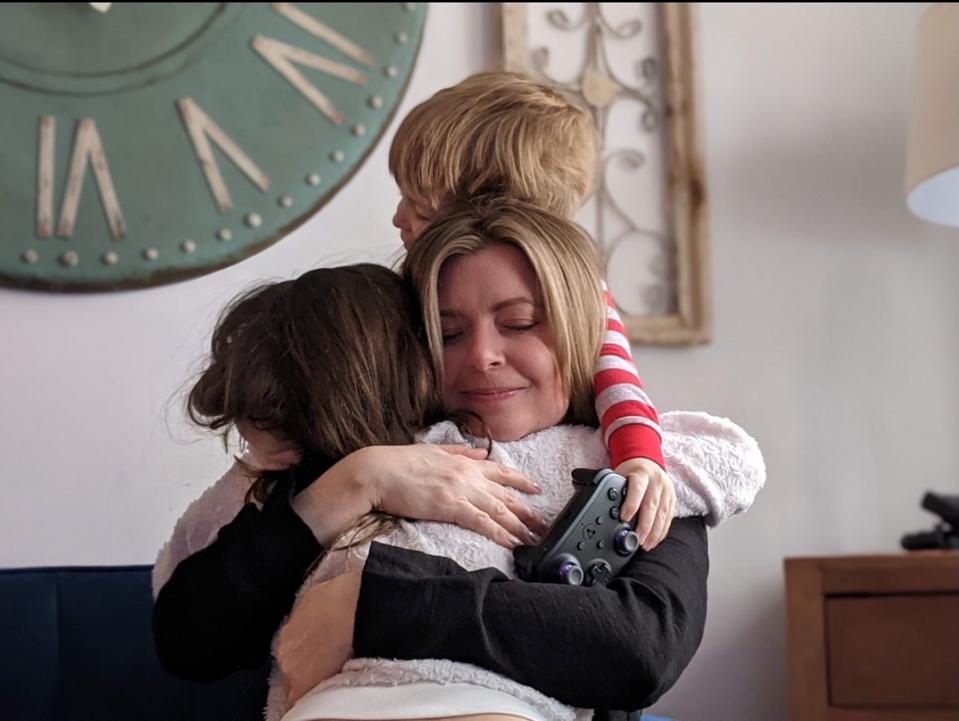
Running a growing company while raising her two young children is challenging. “It’s hard,” she says. “Not just for women. It’s hard for anyone. Your apartment might be a wreck and the laundry doesn’t get done sometimes. And it’s scary. But it’s OK. It’s OK to be afraid. That fear can be what propels you.” Her philosophy is simple. “You just have to jump. Sometimes you hit a rock, sometimes you hit sand,” she says. “But you have to keep jumping and learn how to land better next time.”
Her seven-year-old only recently saw Pixar Putt in person after hearing about it for years. His reaction? It was not “Mom built this.” Instead, he found joy in the worlds themselves. “He said, ‘Oh, there is Luca!’ Or, ‘There are the Cars!’ For me, that says we have done something right,” says Steele.
If young Sydney walked into Pixar Putt today, Steele says she would most likely feel the same spark she did watching the Miami City Ballet. She would wonder at how it all works and have a sense that she belonged to the magic that ignited her sense of hope. “I didn’t know where I fit into this puzzle,” she says. “But I felt like I was a part of it.”