

Copart (NASDAQ:CPRT) is scheduled to announce its earnings in the next week. The company currently holds a market capitalization of $40 billion. Its revenue for the past twelve months stood at $4.6 billion, and it achieved operational profitability with $1.7 billion in operating profits and a net income of $1.6 billion. Although much will be determined by how the outcomes compare with consensus and expectations, examining historical patterns could potentially increase your odds if you engage in event-driven trading.
There are two approaches to achieve this: one can understand the historical odds and position oneself before the earnings announcement, or one can analyze the correlation between immediate and medium-term returns after earnings and adjust their strategy accordingly following the announcements.
View earnings reaction history of all stocks
Investing in a single stock can be risky, but there is significant value in the broader, diversified approach we adopt with the Trefis High Quality Portfolio. Trefis collaborates with Empirical Asset Management — a wealth management firm in the Boston area — whose asset allocation strategies have produced positive returns during the 2008-09 period when the S&P suffered losses exceeding 40%. Empirical has included the Trefis HQ Portfolio within its asset allocation framework to deliver higher returns with lower risk levels compared to the benchmark index.
Copart’s Historical Odds of Positive Returns Following Earnings
Here are some insights regarding one-day (1D) post-earnings returns:
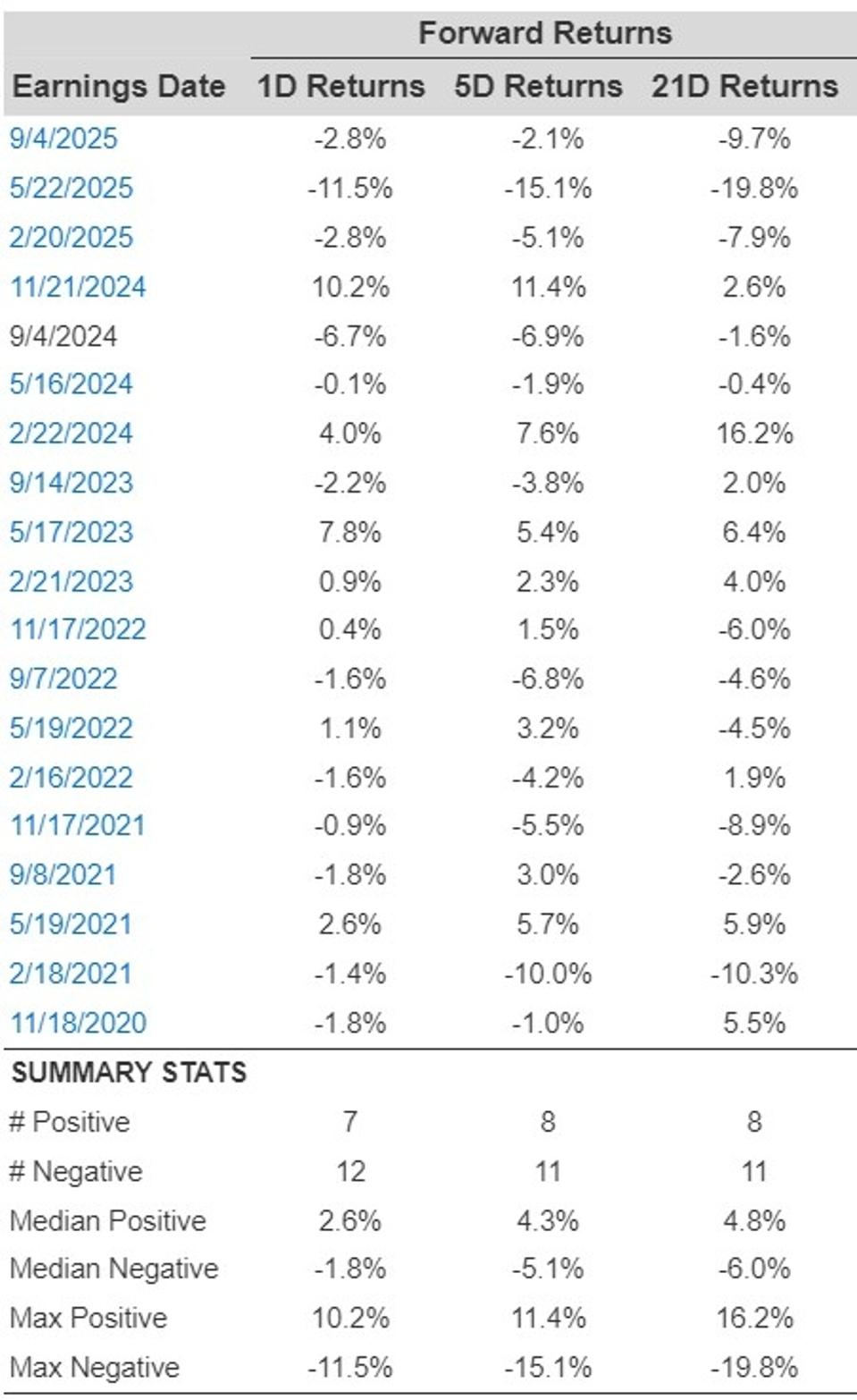
- There are 19 earnings data points documented over the last five years, showing 7 positive and 12 negative one-day (1D) returns. To summarize, positive 1D returns occurred approximately 37% of the time.
- Interestingly, this percentage rises to 45% when considering data from the last 3 years instead of 5.
- The median of the 7 positive returns is 2.6%, and the median of the 12 negative returns is -1.8%.
Additional details regarding the 5-Day (5D) and 21-Day (21D) returns post earnings are displayed alongside the statistics in the table below.
Correlation Between 1D, 5D, and 21D Historical Returns
A relatively lower-risk strategy (though not applicable if the correlation is weak) is to examine the correlation between short-term and medium-term returns following earnings announcements, identify a pair with the strongest correlation, and carry out the suitable trade. For instance, if the 1D and 5D returns exhibit the highest correlation, a trader can position themselves “long” for the following 5 days if the 1D post-earnings return is positive. Below is some correlation information based on a 5-year and a 3-year (more recent) history. Note that the correlation 1D_5D indicates the correlation between 1D post-earnings returns and the subsequent 5D returns.
Is There Any Correlation With Peer Earnings?
Occasionally, the performance of peers can impact post-earnings stock reactions. The pricing may begin prior to the earnings announcement. Below is historical data reflecting the past post-earnings performance of Copart stock in comparison with the stock performances of peers that reported their earnings just before Copart. To ensure fair comparison, peer stock returns also illustrate post-earnings one-day (1D) returns.
* N/A indicates that the peer reported earnings after CPRT
If you are seeking upside with a smoother experience than investing in a single stock like CPRT, consider the Trefis High Quality (HQ) Portfolio, which comprises 30 stocks, has a history of comfortably surpassing its benchmark that includes all three—the S&P 500, S&P mid-cap, and Russell 2000 indices. What accounts for this? Collectively, HQ Portfolio stocks yield superior returns while encountering less risk compared to the benchmark index; resulting in a smoother investment experience, as demonstrated in HQ Portfolio performance metrics.