

If I can give you one piece of advice now, it’s this: Don’t fear this talk of an AI bubble.
In fact, we should love it, because it’s set to hand us a shot at big dividends and gains—especially in closed-end funds (CEFs), which yield around 8% today and regularly hand us “dividend deals” that simply shouldn’t exist.
Our job: Buy, then ride along as CEF investors, who tend to be slowpokes compared to stock buyers, finally come around and bid our funds’ prices up. And we collect those rich dividends—often paid monthly—while we wait.
One CEF is giving us just such a nonsensical discount today: a 7.7%-payer called the Virtus Artificial Intelligence & Technology Opportunities Fund (AIO).
This one holds many key AI players, including Meta Platforms (META), NVIDIA (NVDA), Oracle (ORCL) and Microsoft (MSFT), as well as some companies that stand to gain as they work AI into their daily operations, like JPMorgan Chase & Co. (JPM) and Citigroup (C).
With most of these stocks skyrocketing, AIO should be pricey (“artificial intelligence” is right in the name, after all!). But it’s ridiculously cheap, trading at a 6.7% discount to net asset value (NAV, or the value of the AI stocks it owns).
And any selloff in AI stocks would make it even cheaper.
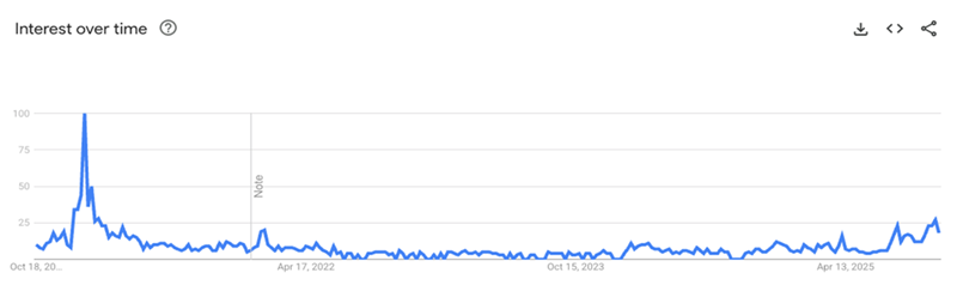
Which leads us back to the question on everyone’s mind: Are we in an AI-driven bubble? That’s critical to a buy of AIO now, so let’s dive in. We’ll start with an often-overlooked measure of where people’s heads are: a chart of common Google searches, in this case for the term “stock market bubble.”
You can see at the right side of this chart that the term has been gaining since hitting a low in September 2024. It’s now at its highest point in almost five years.
Why the bubble fears? Well, if you’ve been investing for a long time, your experience likely includes the popping of two major bubbles: the dot-com bubble in the late 1990s and real estate in 2008. A couple generations were traumatized by those events, and as a result, we’re now in a kind of “bubble” of bubble talk.
But are we really in an AI bubble? I’d say no. To start, let’s present the bubble case at its most dire: A Harvard academic recently suggested that, without AI investment, America’s GDP growth would’ve been a meager 0.1% in the first half of 2025.
There are a lot of problems with this argument. For one, it ignores the fact that a lot of AI investment is imported from abroad (Bloomberg estimates that imports account for about half of all AI investment), and GDP only measures productivity inside a country.
Bloomberg estimates that America’s 1.6% growth in the first half of 2025 would probably be more like 1.1% without AI investment. So, to be sure, AI is contributing much, but not most, of the country’s GDP growth, let alone all of it. Anyone trying to convince you otherwise is simply fear-mongering.
Don’t take the bait—especially when other indicators point to a stable economy:
This chart, for example, tells us that over the last year, Americans have been less delinquent on their credit cards than they were a year ago, and the overall percentage is pretty small—now about 3.1%, much lower than it was in the 1990s and 2000s.
But let’s keep the focus on AI for a moment longer, because it sets up just how out of step that discount on our 7.7%-paying AI fund, AIO, really is.
This chart comes from a recent Yale study showing that the share of workers exposed to AI hasn’t changed since the tech was released. “If AI were automating jobs at scale, we would expect to see a smaller share of workers in some of the jobs that are most negatively impacted,” the authors wrote. Yet this chart shows no change at all.
In other words, AI isn’t making Americans poorer. It isn’t taking their jobs, and it isn’t a bubble set to burst. That doesn’t mean it won’t turn into any of those things—but it is none of them now.
And that sets us up for a tempting trade.
If AI starts taking jobs or making Americans feel more uncertain, we should expect a stock pullback that would hit all sectors, including AI names like Alphabet (GOOGL), Meta and, of course, NVIDIA.
If AI doesn’t take jobs because the tech doesn’t wind up meeting expectations, AI investment will drop and, again, take down names like Google, Meta and NVIDIA.
Of course, everyone is watching these companies’ stocks like hawks, eager to sell at any sign of trouble. And that’s why, if we see a selloff driven by fear that any of the above-mentioned things will happen without data backing that up, they’ll be great buys.
A 7.7%-Payer That’s Cheap Now—and Will Get Even Cheaper in a AI Stock Selloff
That’s where AIO comes back into the picture. It’s a diversified play on AI that rewards investors with that healthy 7.7% dividend, which comes our way monthly.
It’s also a fund we know well at my CEF Insider service: We bought it in September 2020—long before AI was on investors’ radar—and rode it to a nice 23% total return (including its 6.4% dividend at the time we bought) in the following three years.
And, as I mentioned before, AIO is cheap today. In fact, it’s cheaper than it was during the April “tariff terror, ” if you can believe it. That’s a setup that makes no sense at all! Yet here it is:
We saw last spring’s deep discount flip to a premium by June. Now that premium has disappeared again, and AIO is back in bargain-bin territory.
That doesn’t mean it’s worth buying now—but it does mean AIO is more sensitive to sentiment than the AI stocks it invests in. If investors sell off AI stocks, they’ll sell off AIO aggressively, opening up an even bigger discount and boosting its yield (since prices move in opposition to yields). That will be the time to pounce.
Meantime, we’ll keep watching AIO and waiting for that bigger dividend, and discount, to materialize, thanks to the crowd’s overwrought bubble fears.
Michael Foster is the Lead Research Analyst for Contrarian Outlook. For more great income ideas, click here for our latest report “Indestructible Income: 5 Bargain Funds with Steady 10% Dividends.”
Disclosure: none