
The S&P 500 and the price of gold almost never move in tandem. But recent times have been a rare exception.
The benchmark stock index is up 13% this year, and gold has risen 44%, with both reaching new heights Monday—a feat that has occurred six times in 2025, and 10 times in 2024. From 1970 through 2023, it occurred only twice, both in 1972.
Gold typically performs best when the economic outlook is murky, while stocks rise in more favorable conditions. But experts say the dollar’s decline is helping fuel gold hype, amid what strategist Marko Papic calls the end of U.S. fiscal dominance.
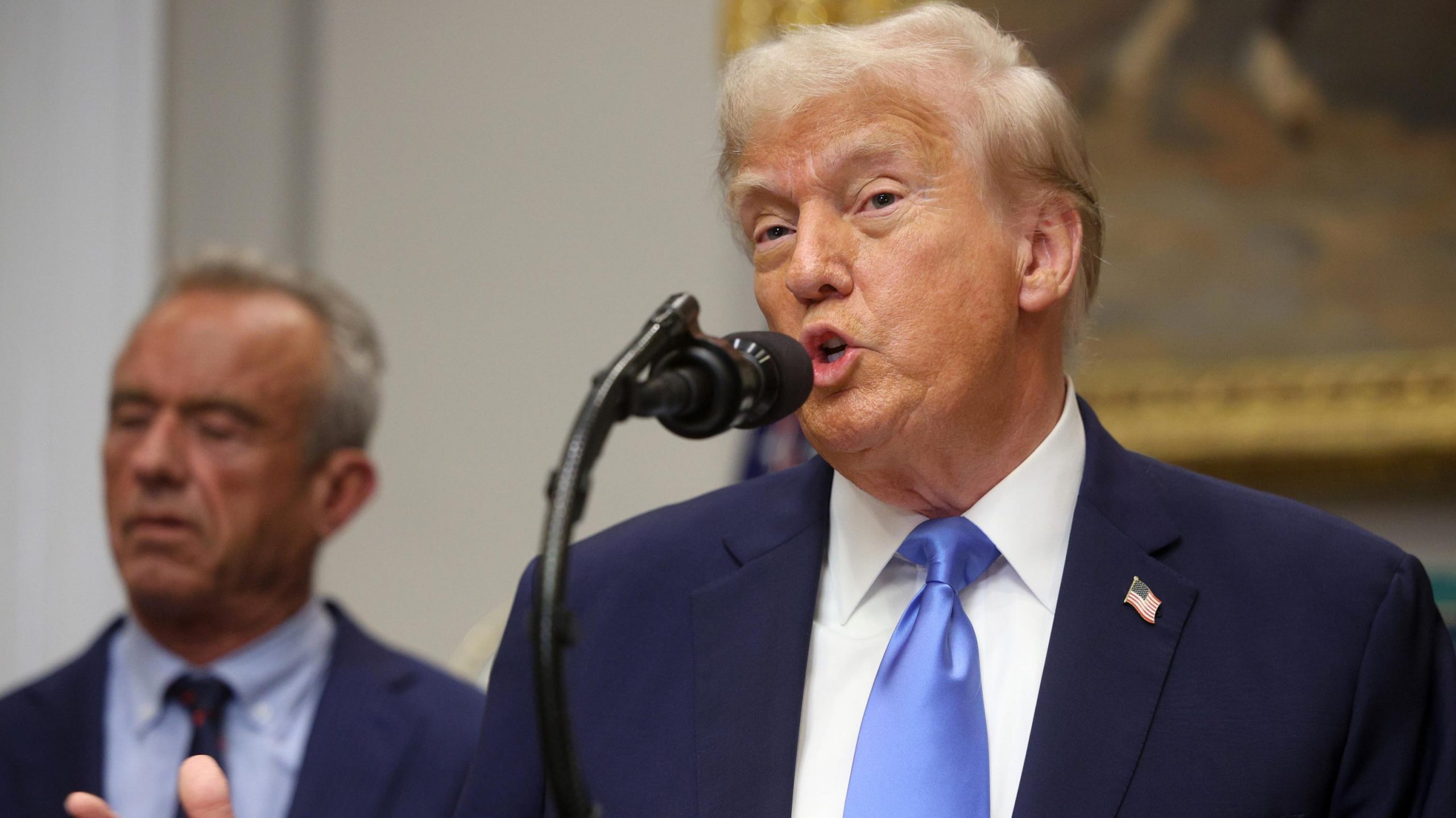
TikTok is flooded with clips of President Donald Trump’s remarks from his Monday press conference promoting unproven medical theories linking vaccines and acetaminophen to autism. Data from analytics company Zelf shows that TikTok videos about acetaminophen, vaccines and autism received more than 100 million views over 48 hours—the most popular of which were posted by the Daily Mail, without additional context to inform viewers that medical science does not support his claims.
President Donald Trump’s signature One Big Beautiful Bill Act caps how much graduate students can borrow, so now the private student loan industry is eyeing billions of dollars in new business. But advocates worry about access for low-income students and the potential for private lending abuses as the Consumer Financial Protection Bureau, which has policed the student loan industry, has been hobbled by the Trump Administration.
The deteriorating labor market outweighed concerns about inflation, Federal Reserve Chair Jerome Powell said, as the central bank cut interest rates for the first time in months last week. Powell described a “challenging situation” in which “near-term risks” to inflation are “tilted to the upside,” while employment risks are also increasing.
Presidents historically benefit from lower rates, since they boost the stock market, but rate cuts are especially beneficial to Trump, whose $7.3 billion fortune is loaded with rate-sensitive assets. For instance, a 1% decline in interest rates could theoretically lift Trump’s real estate portfolio by more than $100 million.
Jacqueline Novogratz and her venture capital firm Acumen set out two years ago to electrify 70 million people in sub-Saharan Africa, largely via off-grid solar power. On Tuesday, Acumen announced it has raised nearly $250 million for the effort from a group of international investors, including Green Climate Fund, Nordic Development Fund and Soros Economic Development Fund.
ABC station owner Nexstar joined Sinclair Broadcast Group in declining to air Jimmy Kimmel Live! on Tuesday following Kimmel’s controversial comments critical of Republicans and President Donald Trump after Charlie Kirk’s murder. Nexstar operates 28 ABC stations and Sinclair operates 38, representing about a third of the more than 200 ABC affiliates nationwide.
As Jimmy Kimmel’s late-night show returned to the air, Kimmel addressed his comments about Kirk’s assassination, saying he does not believe the suspected killer “represents anyone.” But he criticized FCC Chair Brendan Carr and President Donald Trump, saying “a government threat to silence a comedian the president doesn’t like is anti-American.” Meanwhile, Trump attacked ABC and appeared to threaten legal action against the network.
AJ Loiacono started Capital Rx eight years ago to break through hidden fees in drug pricing, and now it’s got its sights set on broader medical costs. Now renamed Judi Health, the startup has raised $252 million in new funding, bringing the company’s valuation to $3.25 billion.
DAILY COVER STORY
No one runs a fast-food business quite like Raising Cane’s founder Todd Graves.
Three decades after scraping together the cash to open his first restaurant, Graves has put up more than 900 Raising Cane’s Chicken Fingers locations in 42 states. It’s one of America’s biggest chains—and one of the fastest growing, currently adding around 125 stores a year. Sales hit $5.1 billion last year, or a staggering $6.6 million per store, second only to Chick-fil-A ($7.5 million) and more than double that of all but six major chains. A typical fast-food joint is lucky to break $2 million.
While most chains offer expansive menus to cater to every taste and shuffle in movie tie-ins or limited-time combos to drive interest, Graves’ menu hasn’t grown up one bit. Raising Cane’s serves just five food items: chicken fingers, crinkle fries, coleslaw, Texas toast and a single dipping sauce. “If you try to be all things to all people, you won’t be special,” he says.
Many of his competitors are selling out to Wall Street firms, including the billionaires behind Subway, Jersey Mike’s Subs and Cane’s competitor Zaxby’s. Graves can’t imagine ever selling. He still writes many of Raising Cane’s marketing campaigns. He personally reviews the kids’ meal toys. He oversees every decoration nailed to every restaurant wall.
His obsession has paid off. Graves is now America’s richest restaurateur, worth $22 billion, thanks to his 92% stake in the business. That places him at No. 46 on this year’s Forbes 400 list.
WHY IT MATTERS “Todd Graves is the classic entrepreneurial success story,” says Forbes senior editor Chase Peterson-Withorn. “He had a vision that others couldn’t see, found a way to fund it himself, then grew Raising Cane’s into a fast-food giant by sticking to what he does best and doing it better than anyone else. Graves is proof that you can get rich in anything, even chicken fingers, if you know what your customers want and are willing to work hard—even risk your life—to give it to them.”
MORE Raising Cane’s Billionaire Nearly Doubles Fortune After Record Year
A majority of Americans believe the economy is either in fair or poor shape, a new poll from The Economist and YouGov found. The findings come just days after the Federal Reserve voted to slash interest rates:
35%: The share of respondents who described the economy as “poor,” while another 32% described it as “fair”
4% and 4.25%: The federal funds rate after the latest Federal Reserve decision, with two more cuts expected this year
54%: The percentage of Americans who believe the economy is getting worse
The era of job hopping appears to be over, replaced by “job hugging,” where employees embrace their current roles—but which approach is better? Traditionally, switching employers led to greater salary increases than company loyalty, but as those companies have tightened their budgets, job hoppers are losing leverage. Nonetheless, moving to a new firm is still the best strategy for salary growth and career advancement, as long as you time it right.
Two popular streaming services will enact another price hike, about one year after their last increase. Which of the following is one of the services?
A. Netflix
B. Hulu
C. Peacock
D. HBO Max
Thanks for reading! This edition of Forbes Daily was edited by Sarah Whitmire and Chris Dobstaff.