

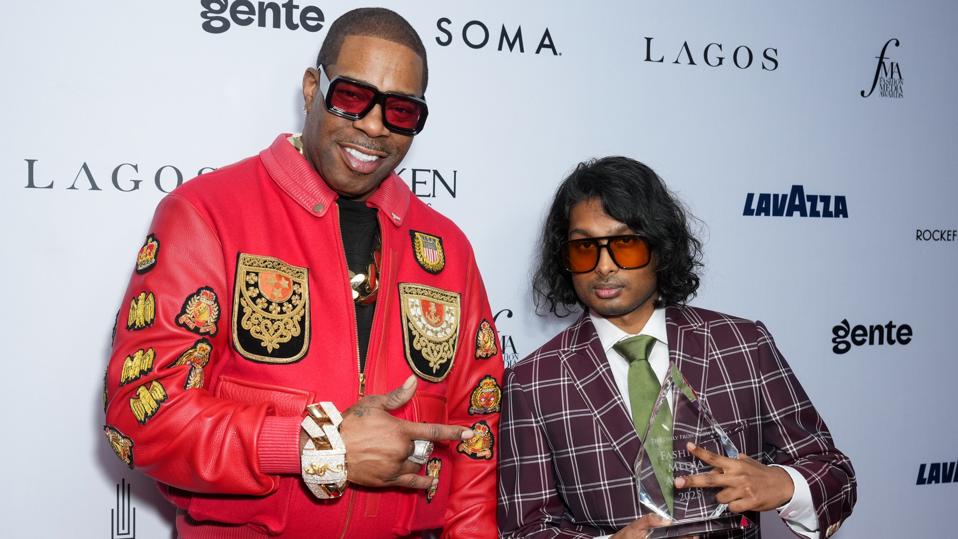
Ashwin Gane isn’t your typical breakout artist. He’s a first-generation Indian American from Detroit, Michigan, building his own brand and carving out a bold and cinematic lane in the hip-hop scene. Just this month at New York Fashion Week, he received the coveted Daily Front Row Emerging Artist Media Award, presented by music icon Busta Rhymes. And his father, Tel Gansen is the serial entrepreneur and man behind Ashwin and the number one trending film on Starz, Trap City.
Ashwin’s performances span from the NFL halftime show to licensing music to ESPN. He’s racked up over 6.5 million combined streams and views, working with production legends like Scott Storch and Justin Bieber’s hitmaker Poo Bear.
But what I’d say sets Gane apart — and why brand leaders should take note — isn’t just the résumé. It’s the strategy. Gane is doing what many marketers struggle to do: building long-term brand value without gimmicks, without noise — just a focused, world-class brand powered by three breakthrough principles.
1. From Template to Truth
Ashwin Gane’s self-described style, Mythic Trap, fuses orchestral grandeur, heavy 808s, and narrative-rich lyrics. But it’s more than a sound. It’s a lens — a belief system. Every element of his brand — visuals, staging, lyrics — reinforces this unified world. As The Hype Magazine put it, Gane’s songs “play like an anthology of emotional survival,” and his music videos channel “A24 meets Metro Boomin.”
This is coherence — not trend-chasing.
Too many brands execute campaigns without a clear philosophy — without a belief system strong enough to stretch across touchpoints and still feel true. Ashwin’s brand has both depth and direction. And it’s no accident.
The more defined your core idea is, the more fluid and original your execution can be. You’re not replicating a template — you’re translating a truth. You don’t need templated guidelines when your brand is already operating with creative conviction.
As I’ve shared in The Kim Kardashian Principle, this is how you build power brands that don’t just engage — they influence. It’s also how you create brand ambassadors who embody your message, not just repeat it.
And the data supports it. Research finds that brand consistency can increase revenue by up to 33%, yet fewer than 10% of companies report strong brand coherence.
Ashwin reminds us: consistency and creativity are not opposites — they’re allies when grounded in identity.
2. Say It Your Way
We talk a lot about storytelling, but Ashwin’s work goes a step further. He’s not just telling a story — he’s asserting the authority to say it his way.
His video for “Leeches” — a psychological thriller in audio form — wasn’t an afterthought. It was a cinematic extension of his narrative. Gane writes, produces, performs, and co-directs. His upcoming EP Twilight Tales plays like a film anthology, with each track acting as a chapter in a larger emotional arc.
He’s not just in control. He’s the author.
This isn’t about perfectionism — it’s about owning the right to shape a story in a way that feels deeply true. Most brands rush to tell stories before earning the authority to say anything meaningful. Ashwin Gane reminds us that authenticity isn’t just tone — it’s ownership.
As I’ve often said: you have to give yourself the authority to say things the way you want to say them. That’s how you build trust. That’s how you stay sane. That’s how you attract loyalty — and yes, even invite polarity. Because breakthroughs require boldness.
The numbers back it up. According to Edelman’s Trust Barometer, nearly 60% of consumers say they buy from brands based on their values and beliefs. In fact, 84% of people globally report that they need to share values with a brand in order to use it.
Meanwhile, Nielsen research shows that ads generating above-average emotional response deliver a 23% increase in sales compared to others.
The takeaway? Don’t just tell better stories ad nauseam. Say something — and say it your way.
3. Use Collaboration to Build Culture, Not Just Buzz
Ashwin Gane’s collaborations — from Detroit creatives to global producers — aren’t just transactional. They’re strategic cultural architecture.
He’s performed at the Fashion Week, NFL, MLB, and NBA halftime shows — and yet his brand remains grounded in Detroit’s ethos. His anthem ‘Way Up’ was featured as the official soundtrack for the 2025 US Open. He’s not borrowing credibility — he’s building connection through his DNA.
Where many brands use influencers to chase relevance, Ashwin uses collaboration to create cultural convergence. He links fashion, sport, regional identity, and genre disruption into a coherent cultural language.
The lesson? Don’t just ride a wave. Design the current.
This is how you move beyond referencing culture to actually reconfiguring it. Brands that build connective tissue — across platforms, aesthetics, and purposes — create the kind of resonance that scales far beyond engagement.
Research from the ANA and Alliance for Inclusive and Multicultural Marketing shows that consumers who view an ad as culturally relevant are 2.6× more likely to see the brand as relevant and 2.7× more likely to make a first-time purchase. Similarly, UM’s Future Impact study found that when socially conscious brands advertise with media partners that share their values, consumer purchase intent more than doubles.
The Myth of the Moment, The Power of the Movement
Ashwin Gane has created viral moments — sure. “Got It” was the #1 trending TikTok sound. His debut single “Regret It” charted on Billboard. But the real power is how he builds myth, not noise.
His EP Twilight Tales isn’t just a tracklist — it’s a concept.
“Every track is a chapter. Every lyric is a strategy.”
You’re right, Ashwin. But I’d also say: Every one of your moves is a lesson.
And for leaders navigating a fragmented, distracted, and demand-heavy marketplace — this is the lesson: Don’t market to culture. Author it.
Named Esquire’s Influencer of the Year, Jeetendr Sehdev is a media personality and leading voice in fashion, entertainment, and influence, and author of the New York Times bestselling phenomenon The Kim Kardashian Principle: Why Shameless Sells (and How to Do It Right)