

We tend to think of AI as unprecedented. But history tells a different story.
Five centuries ago, a modest invention in a German workshop sparked the world’s first information revolution. The printing press, developed by Johannes Gutenberg in the 1440s, didn’t just make books cheaper. It reshaped labor markets, created new business models, destabilized powerful institutions, and upended the balance between truth and misinformation.
In short, it did what AI is doing now—only slower.
If the maritime era offered a blueprint for managing global networks of goods and services, the print revolution provides a playbook for governing information, curating knowledge, and preparing workers for new forms of value creation.
Let’s explore how boards and senior leaders can learn from history—and why systems, not just tools, determine who wins in a technological revolution
Printing as Platform: The First Information Revolution
Prior to Gutenberg, knowledge was expensive and exclusive. A Bible might take a year to copy by hand. Literacy was confined to elites, and monks were the primary “knowledge workers.”
Gutenberg’s movable metal type, paired with oil-based inks and adapted wine presses, changed all that. By 1500, more than 20 million books had been printed in Europe—more than the entire output of scribes over the previous thousand years.
New professional categories emerged: printers, editors, publishers, and translators. New social risks surfaced: information floods, contradictory claims, and hard-to-trace sources. And new organizational challenges followed: How do you verify truth? Who gets to publish? What do you do when the crowd controls the message?
Sound familiar?
Today, AI accelerates the same problems: abundant content, ephemeral authorship, viral misinformation, and institutional erosion. But it also presents the same opportunities: faster knowledge sharing, democratized access, and new cognitive capabilities—if governed well.
Governance Lessons: What Printing Revealed About Power, Risk, and Institutions
The most successful actors in the printing revolution weren’t those who invented the press. They were those who built systems around it.
Cities like Venice thrived not because they had better tech, but because they combined it with:
- Capital markets (to finance book production),
- Distribution infrastructure (across trade networks),
- Liberal censorship policies (that tolerated debate), and
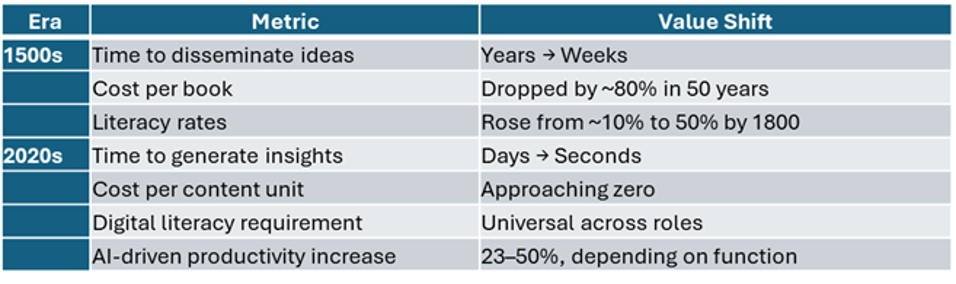
- Investments in literacy (raising reading rates from ~10% to 50% over three centuries).
Contrast that with institutions that tried to suppress information. The Catholic Church’s Index of Prohibited Books (1559) aimed to control content—but only accelerated the underground circulation of banned texts.
Boards and Executive Management Teams today face the same dilemma: should AI be suppressed, siloed, or scaled? The historical record is clear—suppression fails; ecosystem integration wins. As one 2025 Forbes Tech Council article puts it: “The age of AI calls for a new kind of board leadership, one that blends strategic insights with a working understanding of technology”.
AI governance must go beyond compliance. It must address transparency, auditability, and alignment with enterprise purpose—mirroring how printing eventually drove the rise of peer-reviewed journals, libraries, and editorial standards.
Workforce Transformation: From Scribes to Knowledge Synthesizers
The printing press didn’t just destroy jobs—it redefined them.
Scribes became editors. Illuminators became illustrators. Oral teachers adapted to textbook-based classrooms. Scholars shifted from memorization to synthesis. Over time, information workers were judged less on what they knew, and more on what they could do with knowledge.
This is precisely the shift we see with AI:
- Prompt engineers and AI curators are the new editors.
- Digital ethicists and algorithm auditors are the new gatekeepers.
- Workers must evolve from producers to orchestrators of knowledge and content.
McKinsey projects AI could boost productivity by 23% across functions, while GitHub found code copilots improved developer speed by 56%. But the gains only accrue if organizations invest in digital literacy and create pathways for human-AI collaboration.
As Sarah Hernholm noted, “AI literacy should be taught in schools just like math, science, and English—as a fundamental subject necessary for navigating the modern world”.
Metrics That Matter: Then and Now
Boards should track not just AI adoption, but human capital enablement:
- % of workforce using AI tools responsibly
- Internal mobility linked to AI-skills acquisition
- Collaboration between AI and human workflows
- Engagement and retention during transformation
Final Thought: The Truth Problem Is Not New
In the early years of printing, the volume of contradictory content led one 17th-century scholar, Adrien Baillet, to lament the “vast chaos and confusion of books.” It took centuries—and the development of institutions like libraries, peer review, and journalism—to create order.
We’re now facing the same challenge in AI: What’s true? Who decides? How do we verify?
The answer, as ever, lies in governance. Not just policies, but practices. Not just oversight, but systems of value creation.
AI is not the disruptor. We are—in how we choose to govern, guide, and ground this transformation.
The printing press changed the world because it was embedded in an ecosystem of capital, capability, and curiosity. So will AI. But only if boards and leaders rise to the occasion—not as tech buyers, but as stewards of institutional integrity.
Author Note: This article was inspired by an earlier blog co-authored with Stela Lupushor, as part of our ongoing series connecting historical revolutions to AI workforce transformation. This column presents original framing and governance-focused analysis suitable for Forbes.