

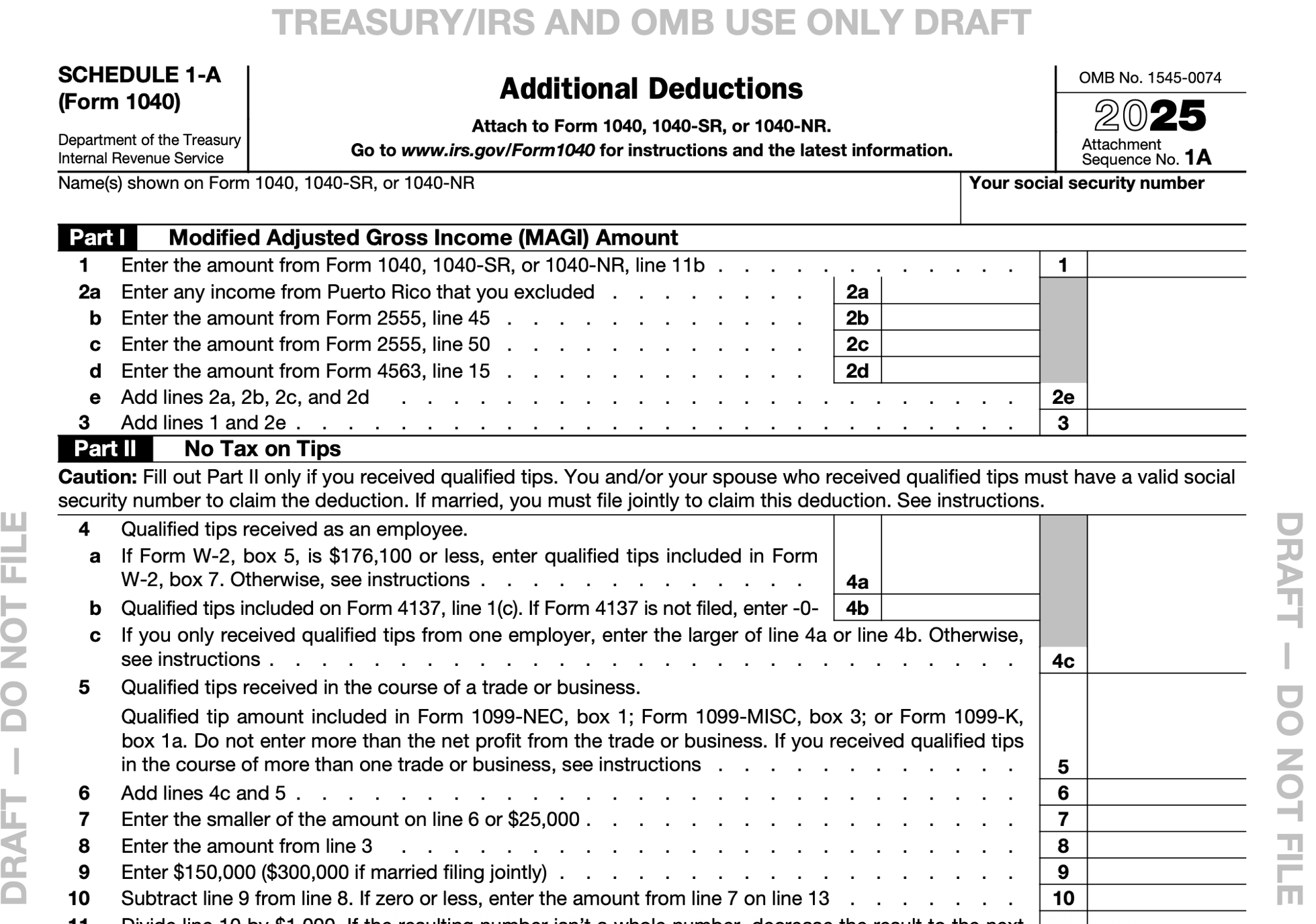
Wondering what tax reporting might look like under the One Big Beautiful Bill Act (OBBBA)? The IRS has released drafts of some 2026 tax forms, including a draft of the new Schedule 1-A, Additional Deductions. The changes are intended to address several new provisions, including those for tipped and overtime workers.
The first item of business on Schedule 1-A? Calculating your modified adjusted gross income (MAGI). That amount—reported on line 3—will be used to determine your eligibility for each of the deductions on the new schedule.
Those deductions are largely referred to on the schedule by their popular monikers: No Tax on Tips, No Tax on Overtime, No Tax on Car Loan Interest. There’s one exception—the provision that was touted as “No Tax on Social Security” is referred to on the form as “Enhanced Deduction for Seniors.” It’s an interesting choice to carve that one out since, if the IRS were being accurate, each of the provisions would be referred to as a deduction—none of the four provisions is an exemption from tax.
With that, let’s take a closer look.
Tips Deduction Reporting and Calculation
Under OBBBA, there’s a new deduction for taxpayers who receive qualified tips—which include voluntary cash or charged tips—in customarily tipped occupations. The deduction is effective for the tax years 2025 through 2028 and can be claimed whether or not you itemize your deductions.
The maximum annual deduction is $25,000, and the deduction for self-employed taxpayers may not exceed your net income before the deduction from the trade or business in which the tips were earned.
Since this is a federal income tax deduction, not an exclusion, tips are still reportable—and taxable at the state and local level.
For the tips deduction, the IRS notes two criteria from the outset: (1) It only applies if you received qualified tips, and (2) you and/or your spouse who received qualified tips must have a valid Social Security number to claim the deduction. Remember that if you are married, you must file jointly to claim this deduction.
You’ll enter the amount of qualifying tips from your Form W-2 (or other reporting form, like Form 1099-NEC, Form 1099-MISC, or Form 1099-K). After totaling those tips, your tentative deduction is that amount or $25,000, whichever is smaller. There’s one more step—taking the phaseout into consideration. A phaseout means that the tax benefit decreases as your income increases. In this case, the deduction phases out with modified adjusted gross income over $150,000 ($300,000 for joint filers).
Here’s a look at how that will get calculated, using the Schedule 1-A. Let’s assume that you have $25,000 for “qualified tips” and your MAGI—that number you figured on line 3 in Part I— is $185,000.
- Compute the excess MAGI over the phaseout threshold ($185,000 − $150,000 = $35,000)
- Compute how much of the deduction is lost due to the phase-out. The phaseout rate results in a $100 decrease in the deduction for each $1,000 that your income exceeds the threshold. So, figure the number of thousands over threshold ($35,000 / $1,000 = 35) and multiply it by $100 (35 × $100 = $3,500).
- Compute allowable deduction. Your final step is to reduce the maximum deduction by the phased-out amount ($25,000 − $3,500 = $21,500).
In our example, the allowable tips deduction would be $21,500.
If you back it out, for a single filer, the deduction would be zero once MAGI reaches $400,000.
Overtime Deduction Reporting and Calculation
There’s also a new, temporary deduction for taxpayers who receive qualified overtime compensation—it can also be claimed regardless of whether you itemize your deductions through 2028. The deductible amount is the bit that exceeds your regular rate of pay—the “half” portion of “time-and-a-half” compensation. As with tips, to qualify, the overtime pay must be reported on a Form W-2, Form 1099, or other specified statement furnished to the taxpayer.
The maximum annual deduction is $12,500 ($25,000 for joint filers).
For the tips deduction, the IRS notes two criteria from the outset: (1) It only applies if you received overtime, and (2) you and/or your spouse who received qualified tips must have a valid Social Security number to claim the deduction. Remember that if you are married, you must file jointly to claim this deduction.
You’ll enter the amount of qualified overtime from your Form W-2 (or other reporting form, like Form 1099-NEC, Form 1099-MISC, or Form 1099-K). After totaling your overtime, your tentative deduction is that amount or $12,500 (or $25,000 if married filing jointly), whichever is smaller. As before, there’s one more step—taking the phaseout into consideration. A phaseout means that the tax benefit decreases as your income increases. In this case, the deduction phases out with modified adjusted gross income over $150,000 ($300,000 for joint filers).
The calculation is similar to the tips deduction calculation. Let’s assume that you have $12,500 for “qualified tips” and your MAGI—that number you figured on line 3 in Part I— is $250,000.
- Compute the excess MAGI over the phaseout threshold ($250,000 − $150,000 = $100,000)
- Compute how much of the deduction is lost due to the phase-out. The phaseout rate results in a $100 decrease in the deduction for each $1,000 that your income exceeds the threshold. So, figure the number of thousands over threshold ($100,000 / $1,000 = 100) and multiply it by $100 (100 × $100 = $10,000).
- Compute allowable deduction. Your final step is to reduce the maximum deduction by the phased-out amount ($12,500 − $10,000 = $2,500).
In our example, the allowable overtime deduction would be $2,500.
If you back it out, for a single filer, the deduction would be zero once MAGI reaches $275,000.
Car Interest Deduction Reporting and Calculation
The new deduction for car interest applies to the tax years 2025 through 2028 and allows you to deduct interest paid on a loan used to purchase a qualified vehicle. It can be claimed regardless of whether you itemize your deductions.
To qualify for the deduction, the interest must be paid on a loan that originates after December 31, 2024, to purchase a vehicle (leased vehicles do not qualify). The original use of the vehicle must start with you (used vehicles do not qualify). The deduction applies to interest paid on a loan for a personal use vehicle (not for business or commercial use) and must be secured by a lien on the vehicle.
A qualified vehicle is a car, minivan, van, SUV, pick-up truck, or motorcycle with a gross vehicle weight rating of less than 14,000 pounds that has undergone final assembly in the United States. If a qualifying vehicle loan is later refinanced, interest paid on the refinanced amount is generally eligible for the deduction.
To claim the interest, you need to report the vehicle identification number (VIN). After totaling the interest (you can claim more than one vehicle), your tentative deduction is that amount or $10,000 (the maximum deduction), whichever is smaller. As before, there’s one more step—taking the phaseout into consideration. A phaseout means that the tax benefit decreases as your income increases. In this case, the deduction phases out with modified adjusted gross income over $100,000 ($200,000 for joint filers).
Here’s how the calculation works. Let’s assume that you have $8,000 in car loan interest and your MAGI—that number you figured on line 3 in Part I— is $350,000 as a joint filer.
- Compute the excess MAGI over the phaseout threshold ($350,000 − $200,000 = $150,000)
- Compute how much of the deduction is lost due to the phase-out. The phaseout rate results in a $200 decrease in the deduction for each $1,000 that your income exceeds the threshold. So, figure the number of thousands over threshold ($150,000 / $1,000 = 150) and multiply it by $200 (150 × $200 = $30,000).
- Compute allowable deduction. Your final step is to reduce the maximum deduction by the phased-out amount ($10,000 − $30,000 = less than zero).
In our example, you would not qualify for the deduction.
If you back it out, the deduction would be zero once MAGI for a joint filer reaches $250,000. You reach the phaseout much more quickly for this deduction than for the tips or overtime deduction—again, not exactly no tax on car loan interest. All of the provisions are subject to limits and phaseouts.
Enhanced Deduction for Seniors Reporting and Calculation
Under OBBBA, seniors are eligible to claim a new, temporary deduction of $6,000—the deduction expires in 2028. The deduction is available to taxpayers who itemize and those who claim the standard deduction. This is a stand-in for President Donald Trump’s promise of “no tax on Social Security”—there is no separate provision.
For the enhanced deduction for seniors, the IRS notes that you and/or your spouse must have a valid Social Security number to claim the deduction. Remember that if you are married, you must file jointly to claim this deduction.
There’s no income to report here (other than taking your MAGI into consideration). After that, the calculation is similar to the tips deduction calculation. Let’s assume that you are a single filer and your MAGI—that number you figured on line 3 in Part I— is $100,000.
- Compute the excess MAGI over the phaseout threshold ($100,000 − $75,000 = $25,000).
- Compute how much of the deduction is lost due to the phase-out. In this case, the phaseout is calculated based on a percentage (6%) and not a fraction. So, take the dollar value over the threshold and multiply it by .06 ($25,000 × .06 = $1,500).
- Compute allowable deduction. Your final step is to reduce the maximum deduction by the phased-out amount ($6,000 − $1,500 = $4,500).
In our example, the allowable deduction would be $4,500.
If you back it out, for a single filer, the deduction would be zero once MAGI reaches $125,000.
Final Steps
When you’ve calculated all of your deductions, you’ll total them and enter that number on the new line 13b on Form 1040 (and no, you’re not seeing things—with all of the changes, line 13 is now on a second page). The amount of that deduction will be subtracted from your income before you calculate your tax.
Remember that tax deductions lower taxable income, while tax credits reduce the tax due. A tax credit is generally more tax-favored than a deduction.
More From The IRS
Of course, the IRS tacked on its familiar warning (well, with a few new tweaks) about drafts to the new form:
This is an early release draft of an IRS tax form, instructions, or publication, which the IRS is providing for your information. Do not file draft forms. We incorporate all significant changes to forms posted with this coversheet. However, unexpected issues occasionally arise, or legislation is passed—in this case, we will post a new draft of the form to alert users that changes were made to the previously posted draft. Thus, there are never any changes to the last posted draft of a form and the final revision of the form. Forms and instructions are subject to OMB approval before they can be officially released, so we post drafts of them until they are approved. Drafts of instructions and pubs usually have some additional changes before their final release.
If you have thoughts to share, the IRS will accept comments online at IRS.gov/FormsComments. Include “NTF” followed by the form number (in this case, it would be “NTF1A”) in the body of the message to route your message properly.
You can see the draft form here.