

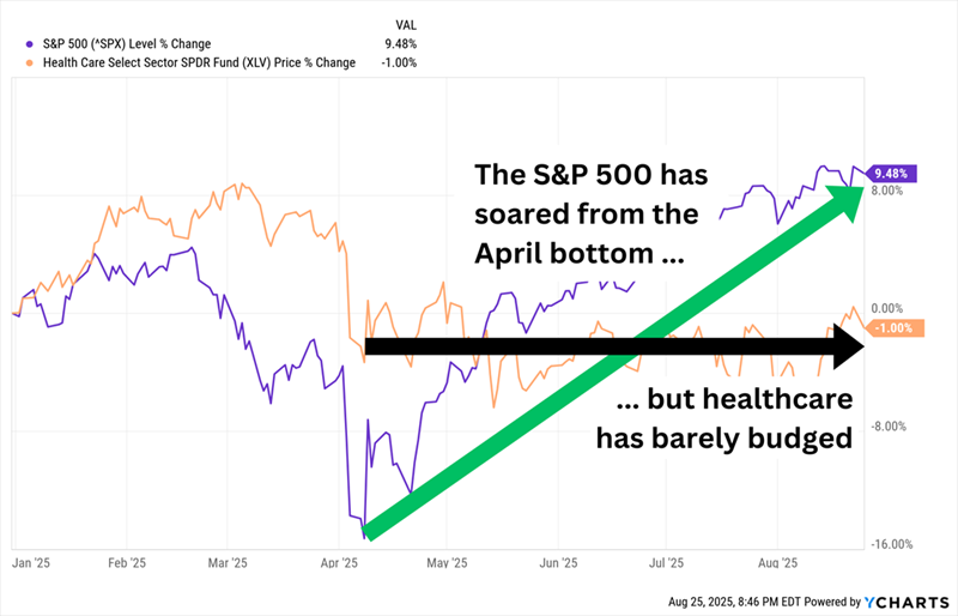
Healthcare stocks haven’t moved since the April lows. As contrarian investors, this neglect piques our interest.
As income investors, seven healthcare yields up to 7.1% are equally intriguing. These dividend deals are available because these stocks have been left behind by the broader market. Since April 7, the S&P 500 has soared a terrific 27% while the healthcare sector hasn’t budged:
Of course there is plenty of uncertainty surrounding these stocks:
- Pharmaceutical tariffs
- Cuts to Medicaid
- Cuts to health research funding
- Initiatives to lower drug costs
- Presidential letters to pharma CEOs demanding they lower drug prices
Let’s wade through this political mess to evaluate these payers. Are they bargains or yield traps?
7 High Yield Healthcare Stocks
We’ll start with Omega Healthcare Investors (OHI, 6.4% yield), a major operator in skilled nursing and assisted living facilities in both the US and UK, with a portfolio of 93,961 beds across more than 1,000 properties that’s leased out to 92 operators.
Omega is technically still recovering from COVID, but thanks to great momentum over the past two years, it’s closing in on its pre-pandemic highs. We can thank a better operating environment and more cooperative interest rates.
The company’s latest quarter exemplifies the progress Omega has seen: It beat estimates for adjusted fund from operations (AFFO, a critical measurement of REIT profitability), raised its full-year AFFO guidance, and it was plenty active with transactions, buying up 57 properties.
There’s a lot to like about OHI, including its recent momentum, a position helped by demographics, a 6%-plus yield and (typically) low volatility. Its recent run higher has kept its price buoyed, however, with shares trading at more than 13 times next year’s AFFO estimates—not expensive, but not value-priced, either. The dividend is also more than due for a bump higher.
Another traditionally low-drama REIT, LTC Properties (LTC, 6.3% yield), is a roughly 50/50 split of assisted living properties and skilled nursing facilities.
But LTC could become jumpier than normal, for better or worse. A few months ago, I explained that LTC was beginning converting some of its contracts from triple-net leases into REIT Investment Diversification and Empowerment Act (RIDEA)-structured contracts that, without getting into the weeds, gives REITs exposure to the real estate’s operations and lets them participate in net operating income (NOI). As of June, the senior housing operating portfolio (SHOP, where LTC is making these conversions) accounted for about 7% of total enterprise value. The company plans to double the segment by year’s end.
It’s still a relative unknown, though the hope is that it could drive significant growth. LTC shareholders would probably take anything that jolts some life into both its shares and its monthly dividend.
Another monthly dividend from the healthcare space is Healthpeak Properties (DOC, 7.0% yield), whose 700 properties include outpatient medical facilities (50% of portfolio income), laboratories (35%), and senior housing (15%). I covered DOC in more detail not too long ago, but in short: There’s a lot to like about the dividend, which was both raised and converted to a monthly payout earlier this year (after a pair of deep cuts in 2016 and 2021) and is well covered by AFFO—but growth could be muted in the near-term given strong headwinds pushing back on its life sciences portfolio.
Sila Realty Trust (SILA, 6.4% yield) is a relatively fresh triple-net healthcare REIT that was founded in 2014 and went public a decade later. It owns roughly 140 medical properties, including 90 medical outpatient buildings, 22 inpatient rehabilitation facilities, and 26 surgical and specialty facilities.
We won’t hear Sila’s name mentioned among the most exciting IPOs, but since going public in June 2024, it has delivered a nearly 20% total return and established a 6%-plus dividend. It also offers a decent amount of financial security: long average lease terms of around a decade, no final debt maturities for a few years, rent escalators, a strong debt position, and a well-covered payout.
One small strike against management, though: SILA initiated a monthly dividend in July 2024 but regressed to quarterly starting this year.
REITs aren’t the only healthcare plays throwing off fat dividends right now, though. We can find some abnormally large distributions in the pharmaceutical space.
Siga Technologies (SIGA, 7.1% yield) has one of the largest yields in the healthcare sector—a whopping 7%-plus payout. But unlike the two blue chips I’ll talk about next, it’s an outlier in two significant ways:
- It has one product. That’s it. Siga makes TPOXX, an antiviral that primarily treats smallpox in adults and children across more than 30 countries, but also is being used for mpox (formerly monkeypox) in the U.S. under an expanded-access program. It’s working on gaining additional indications for TPOXX and does have other drugs in development. Those, however, are in very early stages, which could mean years before they come to market..
- Siga’s dividend is an annual special distribution. That said, Siga has been paying an annual special dividend for four years now—45 cents per share in 2022 and 2023, then 60 cents per share in 2024 and 2025.
Siga is too hyperconcentrated to seriously consider right now, but its extreme generosity (a 7% yield for a single-drug company!) at this relatively early stage is worth noting in case it manages to become a more diversified pharmaceutical over time.
Bristol-Myers Squibb (BMY, 5.3% yield) is a much more diversified pharmaceutical name—and at nearly $100 billion in market cap, a true blue chip of the healthcare space. Most people know it for its cancer treatments Revlimid and Opdivo, as well as the anticoagulant Eliquis, but those are just a few of the biggest names in a broad stable of more than 30 products.
Unfortunately, that diversification hasn’t counted for squat over the past five years. While healthcare broadly has grossly underperformed the market (about 40% to the S&P 500’s doubling) in that time, BMY has been even worse, sitting on about 25% in red ink on a price basis, and a 10% loss even with dividends included. Credit that to plunging sales of Revlimid and other drugs such as Abraxane (to treat a variety of cancers) and Sprycel (to treat chronic myelogenous leukemia).
Still, BMY is coming off a beat-and-raise second quarter, it’s making smart partnerships with the likes of BioNTech (BNTX) and Bain Capital (BCSF), and there’s potential for Opdivo Qvantiq to help mitigate the damage when the main patent for Opdivo falls off the cliff in 2028. Shares also yield more than 5%, and they’re cheap, at just 7 times earnings estimates.
Around this time last year, I said that fellow healthcare blue chip Pfizer (PFE, 6.9% yield) “usually goes on sale once in a blue moon.”
But a blue moon isn’t supposed to last for a year.
At the time, the Pfizer turnaround story revolved around a few potential drivers, including the purchase of Seagen’s oncology drug portfolio, a developing weight-loss pill (danuglipron), and its Paxlovid COVID-19 treatment.
However, since then, Pfizer has pulled the plug on danuglipron after a trial patient “experienced potential drug-induced liver injury that resolved after the medication was stopped.” COVID drug sales are on the decline (and in further potential danger from the current administration). Changes to Medicare’s Part D prescription-drug coverage are dinging Pfizer and other Big Pharma names. And several of its products—including Eliquis, Ibrance, Xtandi, and Prevnar 13—are scheduled to go over the patent cliff across the next five years.
The result? PFE shares have continued to hemorrhage ground, driving its yield to its highest point since the Great Recession—and no other time before that.
For now, Pfizer is trying to cut its way to financial health, targeting more than $7 billion in cost savings by the end of 2027. Does that mean the dividend is in danger of being cut, too? Given an earnings payout ratio of 55%, I’d say “not yet.” And for anyone who wants to risk catching a falling knife, shares trade at just 8 times earnings estimates.
But trimming isn’t enough to convince long-term buy-and-holders. The only way we can have more confidence in Pfizer’s longer-term prospects is to see more success from its pipeline, and stronger growth out of its newer products.
Brett Owens is Chief Investment Strategist for Contrarian Outlook. For more great income ideas, get your free copy his latest special report: How to Live off Huge Monthly Dividends (up to 7.6%) — Practically Forever.
Disclosure: none