

The stock market rally from the April-May lows has been led by growth stocks and as the rally progressed, the focus was on the MAGA 7 stocks. Their loss of 1$ trillion in value on Thursday, April 3rd, in reaction to the Trump tariff plans, startled the markets.
The growth stocks have continued to outperform the market averages. In my work, finding and trading those ETFs that are outperforming the S&P 500 has a dramatic impact on one’s portfolio performance.
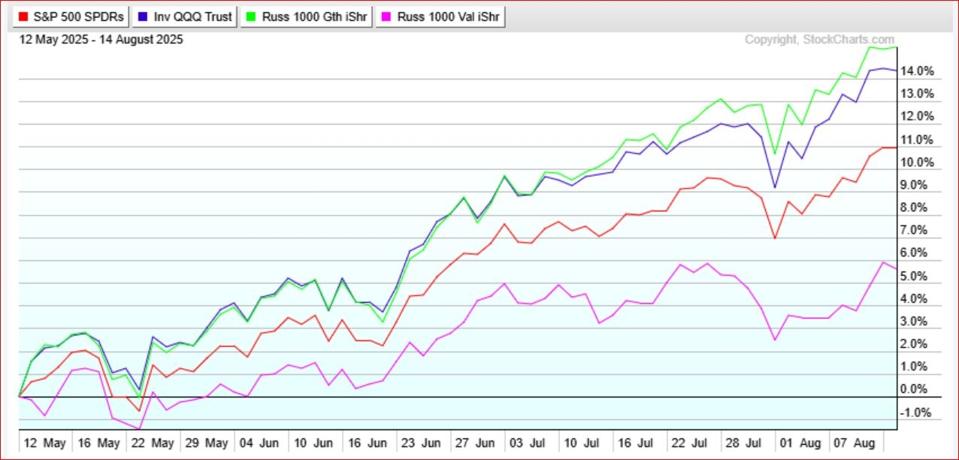
This performance chart compares how the Spyder Trust (in red), with the Invesco QQQ Trust (blue), Russell 1000 Growth IWF (green), and the Russell 1000 Value IWD (pink). The leader is the IWF, up 15% while the QQQ has gained just above 14%. These should be compared to the 11% gain in SPY, while IWD is only up 5.5%. The opportunity to make 10% more by investing in IWF than IWD could make your whole year.
The Invesco QQQ Trust (QQQ) reached an oversold extreme in early April as it spent several days below the daily starc- bands. The technical outlook turned positive on April 24th (line a) as the NDX 100 Advance/Decline line moved above its downtrend, line a, and its WMA.
The NDX 100 Advance/Decline has continued to make new highs until this week. On August 14ththe QQQ had a high of $583.32, but the NDX100 A/D line formed a lower high, line d. A drop in the A/D line below the recent low (see arrow) is required to move the A/D line into the corrective mode. Just one or two higher closes could erase the divergence.
The relative performance (RS) also completed its bottom formation on April 24th when the resistance at line b, was overcome. Since the bottom, the RS has continued to make higher highs with prices and has supported the price action. It would take a drop below the July lows to indicate that QQQ is no longer a market leader.
Another tool that I use to monitor the relative performance of growth versus value stocks is the ratio of the iShares Russell 1000 Growth (IWF) to the iShares Russell 1000 Value (IWD). This approach has been discussed in previous articles. Many investors get a different view of the last 25 years of stock market history when they view it in terms of the ratio.
The rally into the dot.com peak in 2000 was led by growth stocks, and the decline from these highs was led by the value stocks that had been depressed for several years. The IWF/IWD ratio started to bottom in August 2007 as the ratio closed above the 20-month EMA. The solid uptrend continued until 2019 as the ratio accelerated to the upside.
The sharp decline in the ratio from the 2021 highs ended in December 2022, as few were looking for such a sharp growth stock rally in 2023. A number of analysts in early 2023 were instead looking for value to outpace growth stocks. That is contrary to the signals from the RS and growth/value ratio analysis.
Over the past five years, the ratio has continued to make higher highs, line a. The ratio is well above its sharply rising 20-month EMA, which indicates a strong trend with no signs yet of a major top.
The weekly ratio charts are positive as there was an upside breakout above resistance, line a, at he end of July. This does not rule out a 2-3 week pullback. The weekly MACDs and MACD-His are still rising and positive. A classic MACD bottom was formed at the end of 2022. The MACD-His divergences also identified the top in 2021.
There are also no warning signs now from either the monthly or weekly A/D lines that I update regularly in Forbes.com. The recently discussed low cash levels from the BofA Global Fund Manager Survey should not be ignored. As most of you are likely aware, the seasonal trends for stock prices are not strong in the weeks ahead.