

Whats at Stake?
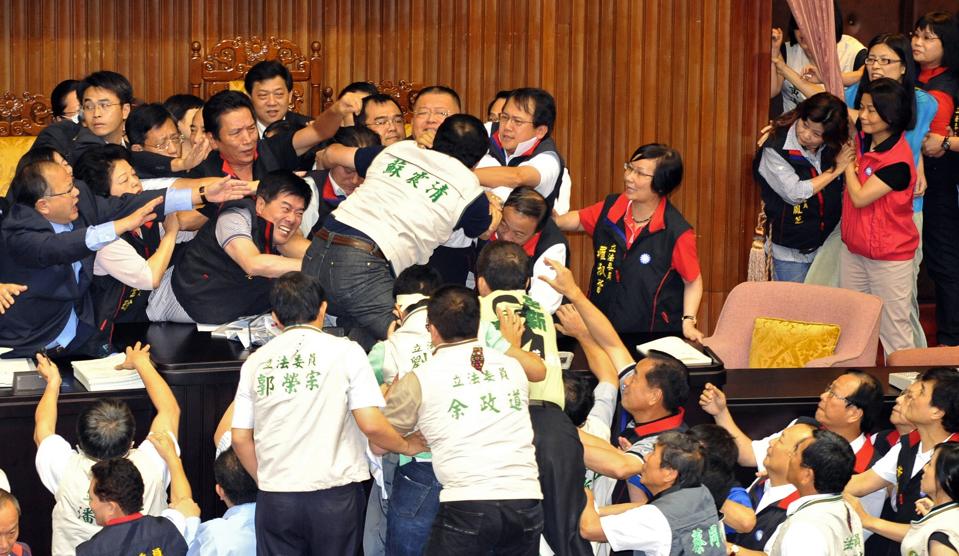
Taiwan is roughly the size of Demark or the state of Maryland, and while known for its exquisite food, night markets, and semiconductor chips is also known for its unique political ecosystem. On Saturday July 26, the Island of 23 million people voted to reject a recall vote in a closely watched spectacle marred by physical brawls by politicians, claims of outside interference by Mainland China, and a heightened social polarization of civil society. Referred to in Chinese as“726大罷免,” or “The Great Recall,” at its core, is a radically different vision of cross-strait relations, domestic politics, and the ability of the DPP to get its agenda through the legislature. Taiwanese President Lai Ching-te and Party Chair of The DPP came to power in January 2024, however the Presidential election cost the DPP to lose control on its majority of the legislature. The 113-seat Legislature is made up of 52 KMT (Chinese Nationalist Party) members, 51 from the DPP, eight from the Taiwan People’s Party (TPP), and two independents aligned with the KMT.
This has huge implications as President Trump has put increased pressure on President Lai to increase Taiwan’s defense spending by 3% of GDP. For the fiscal year 2025, the Cabinet had previously earmarked USD 22 billion or NT$647 billion for national defense, accounting for 2.45 percent of Taiwan’s GDP.
This measure and other core mandates to the DPP have and can be blocked in the legislature. President Lai and the DPP through a “recall vote” were hoping to unseat 24 Chinese Nationalist members which would flip the balance of power in the Legislature. Taiwan’s constitution allows for lawmakers to engage in a recall vote after their first year in office if at least 10 percent of registered voters in their constituency sign a petition. It is a system that makes recalls quite common, but this is a record number of recalls for the island. Another seven law makers are planning for a recall vote on August 23rd.
Supporters of the recall movement have portrayed their campaign as “anti-communist,” citing a meeting between KMT officials and Wang Huning (王滬寧), the chair of the Chinese People’s Political Consultative Conference, on Saturday (April 27). A key objective is to get rid of “pro-China” opposition KMT lawmakers they perceive as collaborators of Beijing’s ruling Communist Party, which vows to “reunify” Taiwan, by force if necessary. However KMT officials argue that President Lai along with The DPP have chosen not to engage in any dialogue with mainland Chinese officials and believe that only through open and sustained dialogue can meaningful changer occur on issues relating to cross-strait relations.
Why was the recall vote rejected?
Up until July 26, massive rallies from both DPP, KMT, TPP and other socials groups alike had seen over 50,000 people gathered to protest in Taipei and other cities. However by Saturday evening according to the Central Election Commission data, the number of voters casting a “yes” vote to recall exceeded the 25 percent of eligible voters, making it the seventh recall vote to meet the required threshold. However, the number of votes in favor of the recall still fell short of the number of votes against it. By Saturday evening TVBS Live noted that there were 94,808 votes in favor of the recall but 121,592 votes against the recall.
An important reason why the recall vote was defeated is a testament to the Taiwanese people’s desire to maintain a thriving democracy and a semblance of checks and balances, but on a very practice level, saw the KMT and TPP work closely together for self-preservation. Professor Kwei-Bo Huang, former deputy secretary-general at the Kuomintang (KMT) and a professor of diplomacy at National Chengchi University in Taipei argues that, “The silent majority spoke and believes that a system of checks and balances must exist to ensure the Republic of China government can maintain democracy which is not ruled by one voice.” He also believed that seeing how the ruling DPP had gained full control over the Executive Yuan and had the ability to sway the Constitutional Court would be setting a dangerous precedent.
DPP Secretary-General Lin Yu-chang (林右昌) in acknowledging defeat of the recall tried to downplay the results of the “recall vote as a win for the KMT and TPP party but rather placing emphasis on Taiwanese voters and their commitment to democracy saying, “This was not a confrontation between parties, but a demonstration of civic power.” The morning headlines of the three major newspapers in Taiwan said it all. The Liberty Times (自由时报) which is a more pro DPP newspaper made no reference at all of the “Great Recall Vote” and instead highlighted Taiwanese athletes attending the Summer World University Games in Germany. The 联合报 (United Daily Press) in its headlines wrote “25:0 The Great Recall A Complete Failure.“ The China Times wrote, “The First Great Recall Vote: The Green Camp Defeated.”
According to the Central Election Commission data, the number of voters casting a “yes” vote exceeded 25 percent of eligible voters, making it the seventh recall vote to meet the required threshold. However, the number of votes in favor of the recall still fell short of the number of votes against it. According to TVBS Live news showed that 94,808 people had voted in favor of the recall vote while 121,592 people had voted against the recall vote.
Broader Implications of the Recall Vote:
Saturdays historic vote has no doubt emboldened and rejuvenated the base of the KMT and TPP in their ability to wield power and influence in the legislature. A key objective is to position the KMT and TPP to advance a more constructive narrative towards cross- strait relations and a check on DPP’s power base and sustain this momentum until the next Presidential election. From the perspective of the DPP, the results of the recall casts doubts on President Lai and raises fundamental questions on how the DPP can pursue their agenda and get it passed through the legislature when they view the opposition parties like the KMT and TPP as undermining democratic institutions and national security by obstructing Lai’s administration, strong-arming controversial laws, freezing defense spending and implementing budget cuts. President Lai also runs the risk of being viewed as a lame duck if recall votes as a tactical approach continue to be defeated.
While the DPP will be under significant pressure to acquiesce to US President Trump in a more transactional relationship, having opposition parties that can balance certain interests may well serve to be more in line with Taiwan’s ultimate national interest. The reality is that the DPP needs to redefine how it engages with Mainland China. Taiwan engaging with Mainland China need not be a zero-sum game. In the same way, Taiwan engaging with the US should not just be about purchasing US military equipment. This is not to say that Taiwan should not invest more in defending its economy, but rather a more wholistic engagement and strategy on trade, education, technology with the US should be pursued as well as developing and coordinating policies with countries like Japan, South Korea, Europe, Australia, India, Southeast Asia and other regional institutions, non-state actors, and entities. Having checks and balances is not just a part of a democracy, it is foundational.
Special thanks to Nathaniel Schochet and Jonah Kim for gathering and sharing articles. I am also grateful to Hanah Kim for gathering and sharing images.