

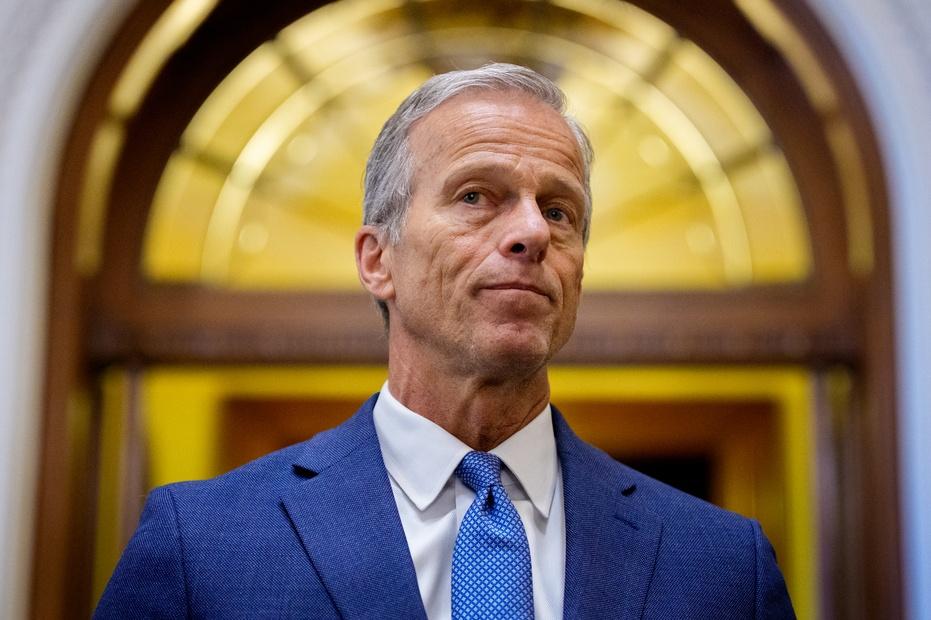
Senate Republicans narrowly passed President Donald Trump’s “One Big Beautiful Bill” with a 51-50 vote after three Republicans—(Sens. Susan Collins (Maine), Rand Paul (Ky.), and Thom Tillis (N.C.)—joined Democrats in voting no. Vice President JD Vance cast the tiebreaker vote.
The tax provisions in the Senate would make permanent a number of the expiring tax cuts contained in Trump’s signature 2017 tax legislation— the Tax Cuts and Jobs Act (TCJA). According to the Penn Wharton Budget Model (PWB Model), a nonpartisan, research-based initiative that provides an economic analysis of public policy’s fiscal impact, making those cuts permanent would increase the deficit by $4.3 trillion over 10 years. These changes would be partly offset by spending cuts of $1.460 trillion for a total conventional cost of $3.104 trillion.
The PWB Model analysis scored the legislation against a current law baseline. That’s also how the Joint Committee on Taxation originally scored the bill.
The baseline impacts how the cost of extending tax cuts is calculated (that’s called scoring) and how it impacts the overall budget. As you know from past bills, including the Bush tax cuts, the Tax Cuts and Jobs Act, and the Inflation Reduction Act, it has long been the case that bills are scored based on the cost to move forward based on current law (so, in all of those examples, any provisions that were set to expire are reset to zero while those previously made permanent are ignored).
Senate Republicans had requested that the JCT rescore it using a new approach called a current policy baseline. With a current policy baseline, extending provisions that are set to expire are scored as having zero cost. The Parliamentarian ruled that the new approach breaks the rules—this is consistent with precedent.
With a current law baseline, the cost of the extensions is fully counted.
Senate Committees
According to the PWB Model analysis, increases in spending under the Armed Services, Judiciary, and Homeland Security and Governmental Affairs Committees would add $290 billion to the deficit. While other committees proposed net spending cuts or revenue increases, the savings amount to only $1.5 trillion, offsetting less than one-third of the $4.6 trillion increase in deficits from tax cuts and spending increases.
You can see how those costs are expected to play out here:
(You can read more about the TCJA extensions as they originally appeared in the House version of the bill here.)
Major Spending Cuts
The Senate bill includes changes to health programs, including Medicaid. Notably, it would cut Medicaid spending by imposing work requirements, restricting state-level taxes on healthcare providers that receive federal matching funds, increasing the frequency of eligibility checks, changing Medicaid eligibility requirements based on immigration status, and phasing down state-directed payments to providers to align with Medicare rates. Overall, cuts to Medicaid would reduce the federal deficit by more than $900 billion.
The bill also reduces spending on the Supplemental Nutrition Assistance Program (SNAP, also known as food stamps) by $186 billion over ten years. The cost doesn’t just disappear—it shifts the responsibility for payment to the states with a new cost-sharing formula. It would also create additional work documentation requirements, shift administrative costs to states, and make other changes to reduce federal SNAP costs.
The Health, Education, Labor, and Pensions Committee eliminates subsidized and income-driven loan repayment plans, imposes new limits on student borrowing, and tightens the eligibility requirements for Pell Grants. Altogether, it would reduce spending by $350 billion over the budget window.
Impact To The Federal Debt
Overall, the PWB Model analysis predicts that the bill would increase debt by 7.6% over 10 years and decrease gross domestic product (GDP) by 0.3% over the same period.
That’s different than the impact to the federal deficit.
Here’s the quick difference between deficit and debt: The federal deficit is the excess of expenditures over revenue in a fiscal year. In simple terms, if we spend more than we take in, we have a deficit. If we spend exactly what we take in, we achieve a balanced budget. If we take in more than we spend, we have a surplus.
The deficit is recalculated annually based on the shortfall or surplus each month. If there is a deficit, the Treasury borrows money to make up the difference. The Treasury accomplishes this by selling securities like T-bills, notes, and savings bonds.
The federal debt is essentially the total of the deficits. So, if we owe $800 million one year and it’s not repaid, and in another year we owe $500 million that is also not repaid, we accumulate a debt of $1.3 billion. Make sense? Since this amount represents borrowed money, we also pay interest on it, causing it to continue growing even if we are not actively adding to it.
Next Steps
Now that the bill has passed the Senate, it moves back to the House. Speaker Mike Johnson can only afford to lose three votes—the last iteration in the House passed 215-214. The versions passed in the House and Senate must match exactly for the bill to become law.