

OBSERVATIONS FROM THE FINTECH SNARK TANK
Cloud accounting leader Xero announced a deal to acquire small business payments platform Melio for $2.5 billion (plus up to $500 million in earn-outs). The acquisition fills a gap in Xero’s offerings by integrating accounting and bill payments.
The Small Business Accounting Burden
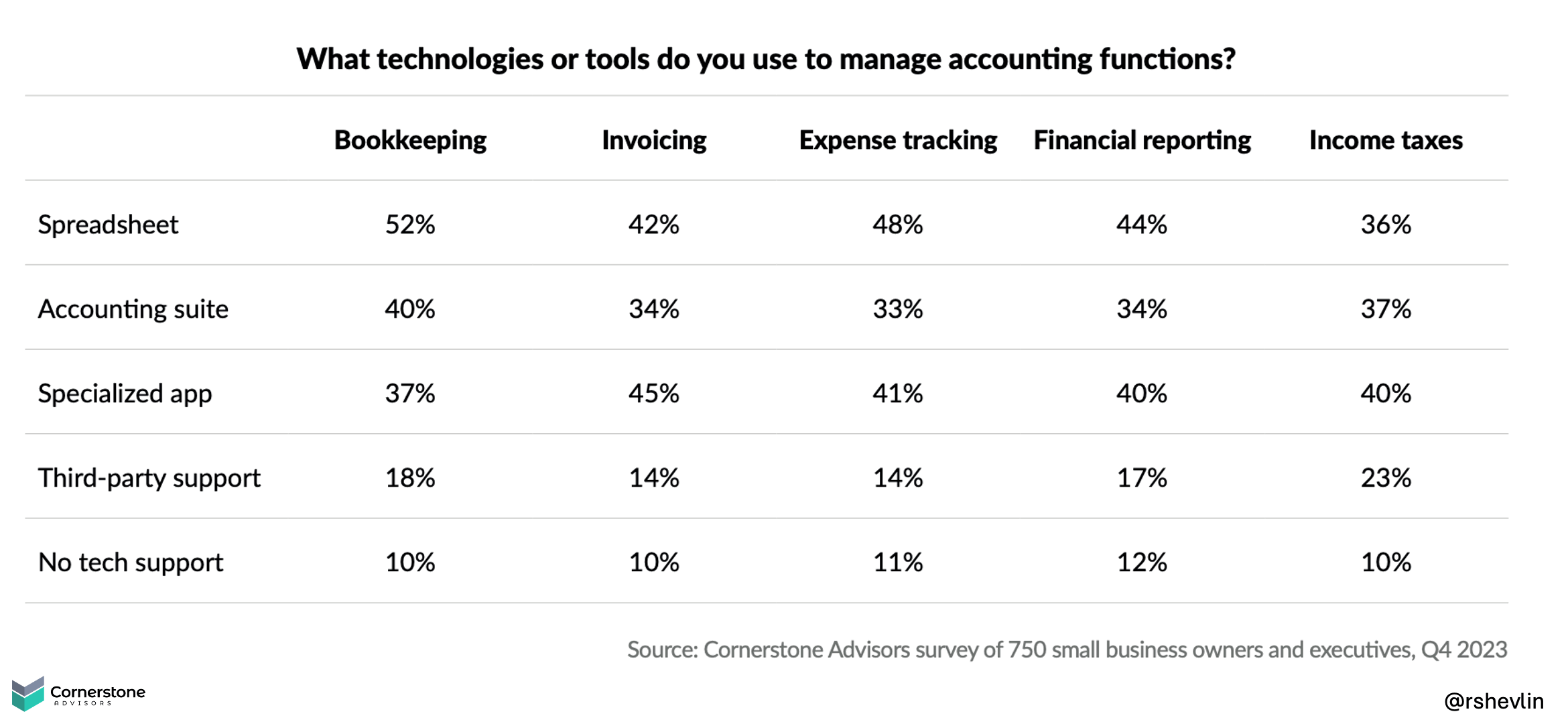
Small businesses have a lot of challenges to deal with and managing—and accounting for—money is a major pain for a lot of them. A Cornerstone Advisors study found that:
- Accounting functions take up an inordinate amount of time. On average, small business owners spend roughly 20 hours each week on accounting functions, evenly split between bookkeeping, invoicing, expense tracking, financial reporting, and tax management.
- Use of accounting technology is disjointed. Between a third and 40% of small businesses use an accounting suite (e.g., QuickBooks, Xero) for each of the accounting functions, but many also use a specialized app as well as a spreadsheet (see table below). The disjointed use of accounting technologies, coupled with the mix of internal and third-party resources, add up to one thing: Accounting is a hassle for many small businesses.
What Melio Brings to Xero
Three big strategic benefits Melio brings to Xero include:
- Integrated payments. Once fully embedded, Xero users will be able to pay bills without ever leaving the Xero app, a convenience that saves time and reduces error-prone toggling between systems. It also provides robust approval workflows, so business owners and accountants have greater control and visibility over outgoing payments.
- Expanded payment capabilities and revenue streams. Longer term, this opens a significant new revenue stream for Xero via payment processing fees and related services, moving beyond pure subscription revenue. Melio processed over $30 billion in business payments in the year up to March 2025, and had revenue of $153 million in that period, so Xero stands to gain transaction-based income alongside its core software subscriptions.
- Accelerated US growth and competitive position. Just 7% of Xero sales come from the US market. Acquiring Melio is a fast-track to scale up in the critical North American market. Melio brings roughly 80,000 US customers and deep market expertise. Importantly, Xero gains Melio’s distribution partnerships with financial institutions and platforms. Melio’s tech is white-labeled by Fiserv (reaching 3,500+ banks and potentially 18 million SMBs) and is used by big partners like Capital One and Shopify.
Bottom line: Xero will be able capture small businesses’ payments flow—not just their accounting ledger–a powerful expansion of its fintech ecosystem.
The New Competitive Landscape in Embedded Accounting
Xero/Melio’s path to growth will face stiff competition from Autobooks. Although the Detroit-based firm’s primary focus is different than Melio’s—accounts receivable vs. account payable, respectively—Autobooks has shown strong growth and momentum in the US small-business fintech space, focused on embedding solutions through banks and credit unions.
Autobooks serves 60,000+ SMBs and, in 2024, and processed over $5 billion in payments through more than 500 financial institution partners. Recent developments include a(n):
- Acquisition. In May 2025, Autobooks acquired Allied Payment Network to add business bill-pay capabilities—moving from accounts receivable only to a full AR+AP accounting platform within banking apps. This strategic move enhances its cash-flow toolkit for SMBs embedded in digital banking.
- Capital influx. Autobooks received a $40 million senior growth loan from Runway Growth Capital. This debt financing supports the Allied Payment Network acquisition and signals confidence in Autobooks’ business model, adding firepower for further growth or additional acquisitions.
- Small business funding capability. The company launched Autobooks Capital in June 2025 to offer short‑term funding directly within the Autobooks platform that SMBs access through their financial institution’s digital banking platform. Autobooks’ Chief Marketing Officer, Derik Sutton, posted on LinkedIn that in its first two hours, 89 small businesses were approved for over $1,000,000 in working capital by Autobooks Capital.
What It Means for Banks and Credit Unions
Banks and credit unions take note: the Xero-Melio deal is another sign that fintech platforms are encroaching on traditional banking terrain in small business services.
Platforms like Xero and QuickBooks increasingly offer things small businesses used to rely on banks for—bill payment, cash management dashboards, and access to credit. With Xero embedding Melio, a business owner could handle accounting, pay all their suppliers, and manage receivables all within Xero, with the bank’s role in the background reduced to moving funds and holding deposits.
For banks and CUs that view fintech platforms as competitors, the pressure is mounting. Fintechs are attracting SMBs by solving pain points banks historically haven’t addressed well. Many traditional banks still offer fairly basic online bill pay and siloed accounts, whereas fintech apps provide “an all-in-one dashboard that combines banking, payments, borrowing and other financial details in a single place” to simplify money management.
For banks and credit unions that partner with fintechs, this development has upsides. Melio has been offered as a white-label service via banking partners (e.g., Fiserv’s CashFlow Central for community banks). Banks that embed or resell the Xero/Melio bill-pay capabilities can deliver a more seamless experience to their SMB customers without building it from scratch.
Bottom line for financial institutions: Accounting/payments platforms are competitors—but they don’t have to be. Instead, they can be new distribution channels for reaching small businesses. Banks and credit unions should explore partnerships with platforms like Autobooks and Xero post-Melio to offer joint solutions.
For banks that choose to compete head-on, the focus should be on what fintechs can’t easily replicate: personalized advice, access to human expertise, and specialized lending. Banks might also invest in their own digital tools like better cash flow forecasting or simple bookkeeping plugins.
In any case, ignoring the trend is not an option. As fintech platforms become hubs for small businesses’ financial activity, banks and credit unions must adapt or risk disintermediation.