

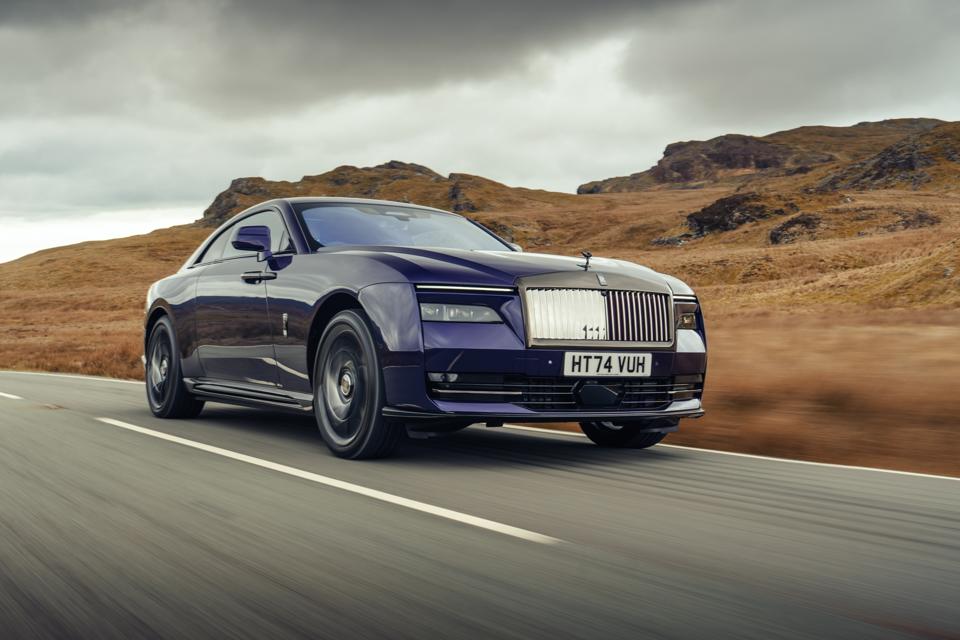
The new Black Badge Spectre is the most powerful car Rolls-Royce has ever made. That fact alone will likely be enough for plenty of well-heeled buyers to take the plunge on the company’s latest EV – but there’s more to it than numbers alone.
Aside from the total output of 650 horsepower and 792 lb-ft of torque – both suitably vast, even for an equally large car that weighs over 6,500 pounds – the new flagship Spectre has a couple of dynamic tricks up its sleeve.
Not long ago, Rolls-Royce would surely blush at the mention of performance car tools like sport mode and launch control. But now, while the vocabulary is suitably elevated, the Black Badge Spectre has such functions. There’s a new button on the steering wheel to engage Infinity mode. This tells the two electric motors to deliver all of their 650 horses – 72 up on the standard Spectre – and increases the sensitivity of the accelerator.
The result isn’t quite night-and-day, but it certainly gives the big Roller a greater sense of urgency at just about any speed. It turns pulling out of tricky junctions or merging onto fast-flowing highways into child’s play.
Next on the new feature list is launch control. Only of course Rolls-Royce doesn’t call it that. Instead the Black Badge Spectre has the aptly-named Spirited mode. A not-at-all subtle nod to the brand’s Spirit of Ecstasy hood mascot, this is accessed by coming to a stop with Infinity mode enabled, then fully pressing both the brake and the accelerator. Pulses of torque are deployed by the motors, giving the impression of a wild animal straining at the leash, before you side-step the brake and keep the right-hand pedal pinned to deploy the full 792 lb-ft of torque – 128 lb-ft up on the regular Spectre.
Do all that and, Rolls-Royce says, its new car will hit 60 mph in 4.1 seconds, a 0.3s improvement on the standard model.
The speedier acceleration isn’t as noticeable as the changes Rolls-Royce has made to the Spectre’s steering and suspension. The former is slightly heavier than before, with greater roll stabilization introduced to increase feedback and reduce body-roll. Meanwhile, the latter has enhanced dampers designed to increase body control and reduce both squat when accelerating and dive during braking. This is where drivers are most likely to notice the Black Badge difference, since the new car is less prone to raise its nose like a Riva Aquarama when you put your foot down.
None of this has suddenly transformed the Spectre into a stiffly-sprung Lotus, but the extra tautness – which is a constant with the Black Badge, not enabled by any mode button – is welcome, even when driven sedately.
The rest of the car is as unparalleled as ever. It’s a huge car, the Spectre, but like all modern Rolls-Royces you very quickly get used to its scale. Even on the smaller roads of the UK, where I’m based, the Spectre fits in and round regular traffic with no more difficulty than a Range Rover.
The levels of comfort and refinement on offer are simply word-class, as you’d expect from Rolls-Royce. The cabin is as quiet as a church, the thick wool carpets are sumptuous and there’s a sense that every single component has been made to the highest possible specification, not to save costs or weight.
Crucially, Rolls-Royce has retained its tactile approach to the infotainment and secondary controls. There’s a touchscreen running a BMW-sourced operating system, but you needn’t ever really touch the display, since there are buttons and switches for everything. Rolls-Royce’s iconic ‘organ-stop’ ventilation controls are still here too, which you pull to increase or push to decrease airflow.
The signature ambient lighting system is still here too, comprising thousands of tiny LEDs installed in the headlining, dashboard and doors. The starlight ceiling looks impressive in standard form, but ask Rolls-Royce nicely and it’ll recreate the stars and constellations of a night sky of your choice, down to the location and even the date.
Further changes unique to the Black Badge Spectre include exterior trim and badged in black instead of chrome, of course, and a new illuminated front grille backplate. Color choices for this statement piece include Tailored Purple, Charles Blue, Chartreuse (yellow-green), Forge Yellow and Turchese (turquoise). New illuminated Black Badge tread plates for the door sills can be ordered to match or complement the grille backplate, and are available in 10 colors.
Inside, changes for this model include a unique pattern on the illuminated dashboard fascia, which sits ahead of the front passenger and incorporates the infinity symbol used across the rest of the Black Badge family. I’m not usually a fan of excessive carbon fiber detailing, especially on a car that plainly doesn’t benefit from the lightweight material. But I rather like the “Technical Fiber” used here. It’s a diamond-shaped weave that uses carbon and a fine metal thread laid atop a black wood base, then sandblasted and sealed with a half-dozen layers of lacquer.
The battery capacity and maximum charge rate are the same as before. This means a whopping 102 kWh and 195 kW. The former is huge, but the latter isn’t the best in the business since the Spectre runs at 400 volts and not 800. Rolls-Royce claims an electric range of between 306 and 329 miles, but at the start of my drive I saw just 257 miles at about 95 percent. That said, Rolls-Royce claims the majority of Spectre drivers charge exclusively at home.
Ultimately, this is the Spectre we already knew and loved, but with the wick turned up. It has a bit more power (unlocked by software alone, by the way, no new motors to report), a quicker 0-60 time, slightly heavier steering and a bit more composure that manages not to rob any comfort. Since money is somewhat irrelevant at this level – $400,000 to $500,000 is generally where these cars land – I suspect almost all Spectre buyers going forward will pick the Black Badge, simply because it’s the newest and has the biggest numbers.