

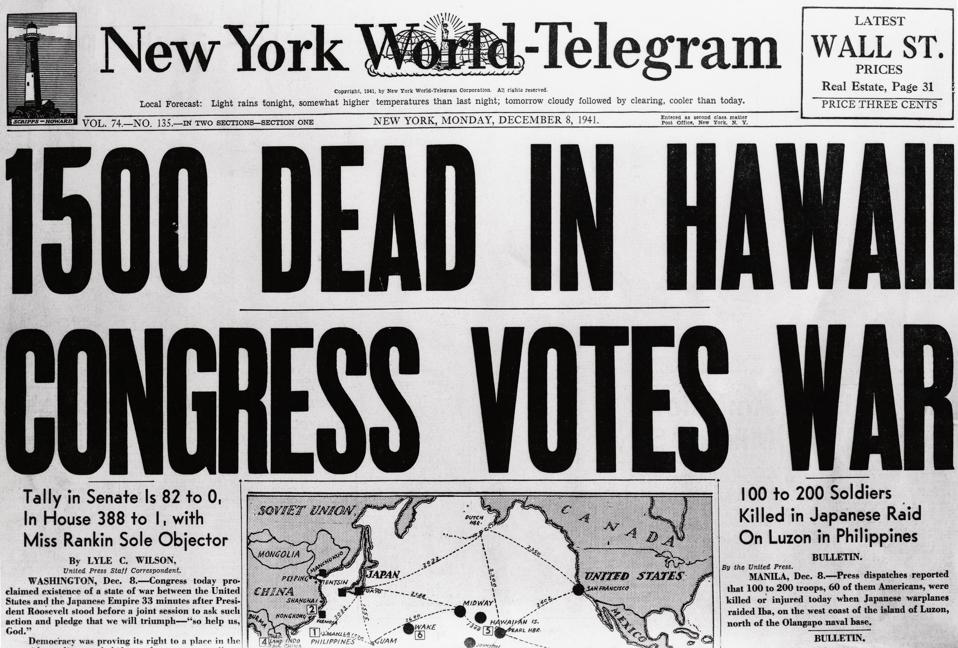
December 7 is the 82nd anniversary of Japan’s surprise aerial attack on Pearl Harbor, which killed thousands of U.S. military personnel and led to America’s entry into World War II. The National World War II Museum in New Orleans is scheduled to hold a commemorative ceremony today — one month after the museum opened a new three-story pavilion highlighting the end of the global conflict.
The museum, designated by Congress as the nation’s official World War II museum, has numuerous photos and veterans’ audio and video accounts of the Pearl Harbor attack in Honolulu. The items are a small portion of more than 250,000 artifacts and 9,000 personal accounts of the war within the museum.
“Pearl Harbor is not only the event that forced America into World War II but marks the beginning of the nation rising as a world superpower,” says Michael Bell, the executive director of the Jenny Craig Institute for the Study of War and Democracy, which provides historical expertise to the museum. “While the war still needed to be fought and won, December 7 is the date when the American people coalesced in a manner never seen before to become global leaders in the fight for freedom of speech and worship and freedom from fear and want.”
December 7 also reminds “our nation of the perils of isolationism, the need to protect democracy and the dangers of being ill-prepared,” Bell adds. “Perhaps no event resonates more in American history.”
The Pearl Harbor attack decimated the U.S. Pacific Fleet, destroying numerous aircraft and battleships. The next day, the United States declared war on Japan, and, three days later, Italy and Germany declared war on America.
The Japanese Imperial Navy, according to the museum, began the Pearl Harbor onslaught on Nov. 26, 1941, when they ordered an armada, including 414 airplanes aboard six aircraft carriers, to set to sea. The attack plan was devised by Admiral Yamamoto Isoroku, who had studied at Harvard and served as Japan’s naval attaché in Washington.
To catch America by surprise, the museum says, the warships maintained radio silence during their 3,500-mile sail from Hitokappu Bay to a position 230 miles north of Oahu. At 6 a.m. on December 7, Japanese planes lifted off from the carriers, followed by a second wave 60 minutes later.
U.S. forces were completely unprepared, according to Rob Citino, a miltary historian at the museum. In less than 90 minutes, Japanese planes destroyed or damaged 19 U.S. ships and 300 aircraft and killed more than 2,400 U.S. military personnel. Nearly half of the dead were crew from the battleship USS Arizona, which sank within minutes after a bomb struck and ignited more than a million pounds of ammunition. The ship’s remains still lie in the waters of Pearl Harbor.
A fragment of the USS Arizona is in the museum.
“This fragment of the ship’s armor speaks to the violent nature of the explosion and how quickly the American Pacific Fleet was reduced,” Bell says. “However, from that event, the U.S. would refloat all but two of the eight battleships sunk or damaged that day and built an even larger fleet more capable of destroying enemies in their own waters.”
Other Pearl Harbor artifacts at the museum include a wristwatch of Roy Boreen, who was aboard the USS Oklahoma during the attack, and the tool chest of a civilian volunteer and carpenter who helped repair damaged buildings.
“The call to battle stations sounded at 7:55 a.m., and, seconds later, the first of several torpedoes struck the Oklahoma,” Bell says. “Hearing the order to abandon ship, Boreen leapt into the water and swam toward the battleship Maryland. He climbed safety aboard the Maryland, where he had a cup of black coffee and smoked the first cigarette of his life. He realized that his watch had stopped at 8:04 a.m., the moment he hit the water.”
Last month, the museum opened its new Liberation Pavilion, which, besides documenting the end of World War II, documents the Holocaust, the immediate postwar years and the war’s continuing impact today. More than 580,000 visitors came to the museum July 2022-June 2023.
“With the completion of our $400 million expansion and the opening of Liberation Pavilion, we expect to see visitation continue to grow in the next year as we build back to our pre-pandemic visitation records of more than 700,000 visitors,” Bell says.
The historian explains why it is important for Americans to know their country’s wartime history.
“Democracy and freedom are not universally accepted ideas or concepts,” Bell says. “Even in the aftermath of World War II, dictatorships and authoritarian regimes still threaten democratic ideals and human rights, and, consequently, those ideals require constant defense and protection. Each generation of Americans needs to understand that, while they have inherited freedoms, those freedoms come with a responsibility as well, to protect human rights, defend democracy and support the cause of freedom at home and around the world.”