

A foundational tenet of American culture–of Western civilization–prioritizes the individual. The rugged individual. The do-it-yourselfer. The lone wolf. The lone ranger. The lone genius.
Artist Sonya Clark (b. 1967; Washington, D.C.) rejects this.
Even when working by herself, Clark recognizes she’s part of a collective effort.
“If I make a work with a piece of linen, I know that I’m in collaboration with the Earth that grew the linen, the sun, with nature, and then collaboration with whoever was working at the factory who spun and wove the linen,” Clark told Forbes.com. “It already has passed through nature’s creation and the hands of the people who have made the product.”
Her collective perspective runs deeper than her artwork.
“I myself am a collaboration,” Clark said. “I wasn’t born into this world without a collaboration. Literally, my mother and father had to get together for probably 20 minutes–hopefully longer. I’m built like my father who had long fingers. When I look at my hands working, I see my father’s hands in my own hands, collaboration. I’m a composite of all the ancestors who have come before me.”
Clark’s chosen profession rarely celebrates, or even acknowledges, this.
“Selfhood, especially when it comes to artistic practice, especially when we think about it through a Western mode, which I resist, is this self-identity, the artist as genius–I’m not calling myself a genius, but this solo person who makes this thing,” Clark said.
The icon. The maverick.
Michelangelo toiling away in solitude, suffering for the Sistine Chapel ceiling, his genius and his genius alone being responsible for its creation.
“We know he couldn’t do that by himself, it’s not possible, but we name it for one genius to hold up the genius trope,” Clark said.
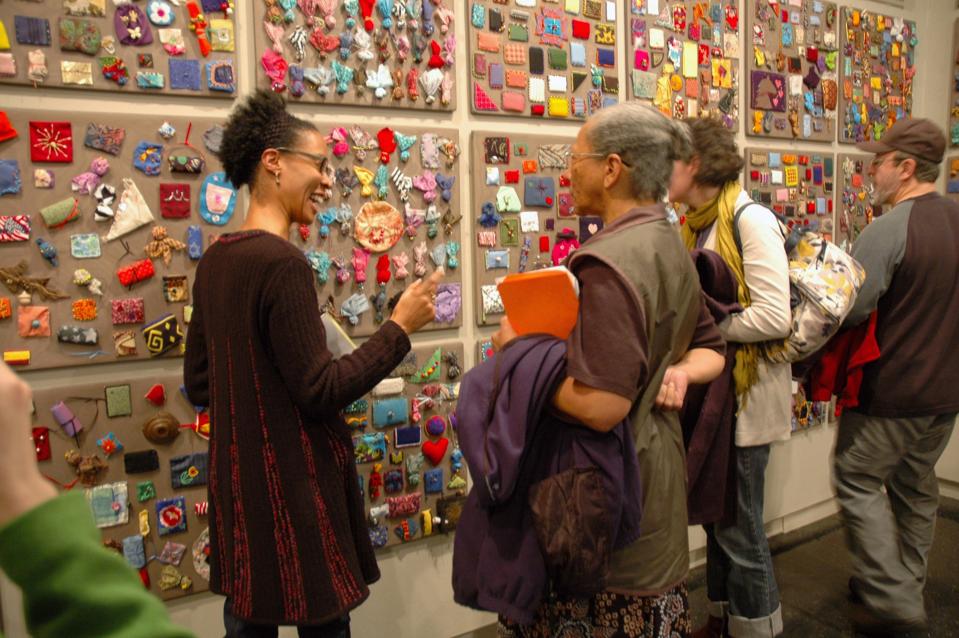
Further rejecting the solitary artist mythology, Clark routinely welcomes public participation into her largest pieces.
“I’m inviting all of those other people to come in and make the work with me because that helps me understand the work better,” she explained. “As they are making the work themselves, they are bringing their own stories in a way that makes the work theirs. As an artist, I want the artwork to resonate with people, if you’re part of it, it literally resonates through your body.”
Clark’s large-scale, community-centered, and participatory projects are brought together for the first time during the exhibition “Sonya Clark: We Are Each Other” on view now at the High Museum of Art in Atlanta through February 18, 2024.
‘We Are Each Other’
There is a danger in the extreme individualism currently popular in America. It promotes narcissism. Those figures then become demigods in their chosen fields of politics, business or tech. Rarely do their self-interests, which they’ve been rewarded for placing above any other interest, serve a greater good.
Extreme individualism is anti-social. Dog eat dog.
“It separates us from one another and holds up one and says, ‘this one is special,’” Clark said. “Anything that is special about me–because I do think there’s special things about me, I’m not egoless–but anything that is special about me is something about my upbringing. It’s something about a positive or negative lesson that I’ve learned from my community, about how to be and how not to be. I am those lessons.”
The narcissist, the individual run amuck, doesn’t recognize the influence of community. Doesn’t recognize influence at all. He or she believes they are a singular creation, their “greatness” resulting solely from within, perhaps divinely inspired.
The ethos of Clark’s participatory works is embedded in the exhibition title, which is inspired by the Gwendolyn Brooks poem “Paul Robeson” (1970), about the civil rights activist, which closes with, “we are each other’s harvest/we are each other’s business/we are each other’s magnitude and bond.”
We are each other.
Forgetting we are each other results in the pandemic hoarding of toilet paper, a vicious application of capitalism resulting in a second Gilded Age, haves and have nots, justification of bombing civilians in Gaza and a rise in antisemitism.
When we forget we are each other, we create “others.” And others are easier to abuse.
“When we remember that we are each other–you are me, I am you–we’re not the same person, but we are both human beings, and if I acknowledge your humanity and you acknowledge mine, the fullness of your humanity and the fullness of mine… (it) allows us to say we’re complicated,” Clark said. “There’s goodness in there, but there’s all the range of all the other things in there as well. If we focus on one thing over the other, then we’ve flattened ourselves and when we flatten ourselves, we also potentially can dehumanize each other.”
Individuals don’t dialogue, they monologue. They are not open, they are closed. Clark’s community-centered projects on view in “We Are Each Other” facilitate open dialogue, new collective encounters across racial, gender and socioeconomic divisions.
The Cradle of the Confederacy
Clark is acclaimed for using everyday fiber materials such as hair, flags and found fabric, along with a range of textile techniques including weaving, braiding, quilting and beading, to examine issues of history, racial injustice, cultural legacies and reconciliation.
The exhibition features six of Clark’s projects created through mass participation, two directly addressing the Civil War, a theme common to her artmaking.
Unraveling (2015-present) is an ongoing performance whereby Clark works alongside individual gallery and museum visitors to unravel a Confederate battle flag thread by thread. The performance is slow and toilsome, meant to symbolize the collective work involved in the dismantling of the ideas of the Confederacy, white supremacy and racism in the United States.
Monumental Cloth (2019) is a series of artworks and activations based on the historic repurposed dish towel that was used to signal a truce by Confederate forces at Appomattox in 1865. Visitors are invited to weave recreations of the flag on looms in the galleries and make tracings of the flag’s waffle-weave surface pattern to take home.
On view at the High Museum of Art in Atlanta, one-time Confederate stronghold, 15-miles as the crow flies from the most prominent monument to the Confederacy and the white supremacy and white nationalism it stood for, Stone Mountain, these pieces hit differently than they did at Cranbrook outside of Detroit where the show opened or the Museum of Arts and Design in New York where it goes next.
“I am cautious to demonize the South,” Clark, who spent 12 years living in Richmond, VA and now teaches at Amherst College in Amherst, MA, said. “When (my family) moved from Richmond to western Massachusetts, the number of people who said, ‘oh, you must be so happy to be out of the South, that very racist place,’ and I was like, ‘have you spent much time in Boston?’ People migrate, ideas migrate, and the North is implicated in the business of slavery.”
Clark has staged the Unraveling project in the North and South.
“I’ve found the responses, regardless of where I am, to be as wide ranging as people are,” she said. “I came because my uncles are part of the KKK and I’m doing this in opposition to them.”
She heard that in New York.
She remembers a pregnant woman telling her, “I came because my partner is a Black man and I’m carrying a Black male child and that is making me think about racism and my privilege in this country in a whole different way–literally carrying a Black body within my white body and what does that mean to protect this child?”
She remembers participants sufficiently triggered by the Confederate flag they didn’t even want to touch it for its representation of white supremacy and white terrorism.
“I came because my wife made me do it, my wife dragged me to the museum,” Clark remembers hearing. “She’s next in line. And then the next word out of this white man’s mouth was, ‘I guess whoever loses is the bad guy.’ That’s what he said. I was like, ‘okay, now we’re gonna’ have to unpack that.’”
It is the Confederate dishrag of surrender, not the occasional Confederate battle flag, Clark wishes were better known. That is the intention behind Monumental Cloth.
“That was the cloth that was used by (Confederate General Robert E.) Lee to call for surrender and truce at Appomattox and it was half a dish cloth that was pressed into service. It was a white linen cloth with three minimal red stripes on either side because they couldn’t find a pure white cloth, and they used this to signal surrender of the Confederate army,” Clark said. “That’s the cloth we should be focusing on rather than the way that we hold one of the many Confederate battle flags, the one that has been come to known as the Confederate flag, that got used by Confederate armies, but the reason we know it is because of the rise of white terrorism around the KKK and then its infusion into popular culture.”
Clark first saw what is now recognized as the Confederate flag–the “stars and bars”–as a child on “The Dukes of Hazzard.” From 1979 through 1985, the CBS comedy featuring the Confederate battle flag painted on Bo and Luke Duke’s souped-up 1969 Dodge Charger, lovingly referred to as “the General Lee,” was one of the top-rated shows on television.
Hazzard, incidentally, was a fictional county in Georgia, how far from Atlanta, who’s to say?
“(It was used passively) really as propaganda,” Clark said. “Like, ‘this flag isn’t so bad; this flag of white terrorism isn’t so bad, right?’”
As Waylon Jennings sang in the theme song, “just some good ‘ole boys, never meanin’ no harm.”
Bo and Luke may have just been “some good ‘ole boys, never meanin’ no harm,” but millions of other Southerners, and non-Southerners, who carried that flag in the 20th century and continue doing so today, do mean harm.
“(Monumental Cloth) becomes a pushback of that,” Clark said. “What about the flag that is saying the end of white supremacy, the end of slavery, the end of this war? What would that mean if we focus on that?”
Around the ‘A’
Atlanta, in no small measure because of its devastation during the Civil War and the reduction in Southern wealth and then Jim Crow racism which followed, has lagged other American cities its size when it comes to the arts. That’s finally changing in a major way.
The Atlanta arts scene has never been as robust as it is today.
Visitors to town arriving through the world’s busiest airport, Hartsfield–Jackson Atlanta International Airport, should make time for “This Land Calls Us Home: Indigenous Relationships with Southeastern Homelands,” an exhibition on view in the gallery space on Concourse T between gates T13 and T14 through fall of 2024.
“This Land Calls Us Home” highlights contemporary Native American artists and designers as they display how ancestral homelands are integral to their present lives through visuals and literature. The works express the visions and voices of Cherokee, Mvskoke, and other Native Americans living within, near, and beyond the Southeastern homelands.
Two presentations celebrating the work of Benny Andrews (b. Plainville, GA; 1930 – 2006) can be seen at Emory University, four miles from The High.
Celebrated international artist Yinka Shonibare, CBE’s (b. 1962, London) 20-foot-tall Wind Sculpture (IV) was unveiled in the Centennial Yards development downtown in the fall of 2023.
Visiting art lovers looking for a place to crash will enjoy Buckhead’s Hotel Colee or Midtown’s The Kimpton Shane. The boutique Hotel Colee partnered with The Print Shop by The FreeMarket Gallery to showcase prints from local female artists in their lobby art gallery. The Kimpton Shane opened its doors in September of 2022 with an art program curated by Atlanta-based art consultant Soho Myriad featuring works from numerous local artists.
The first global art fair to be held in Atlanta was announced this October, with the debut event being held in October of 2024.
Sadly, amongst this energy, the Atlanta arts community lost a giant on November 14, 2023. Radcliffe Bailey was only 55.