

Topline
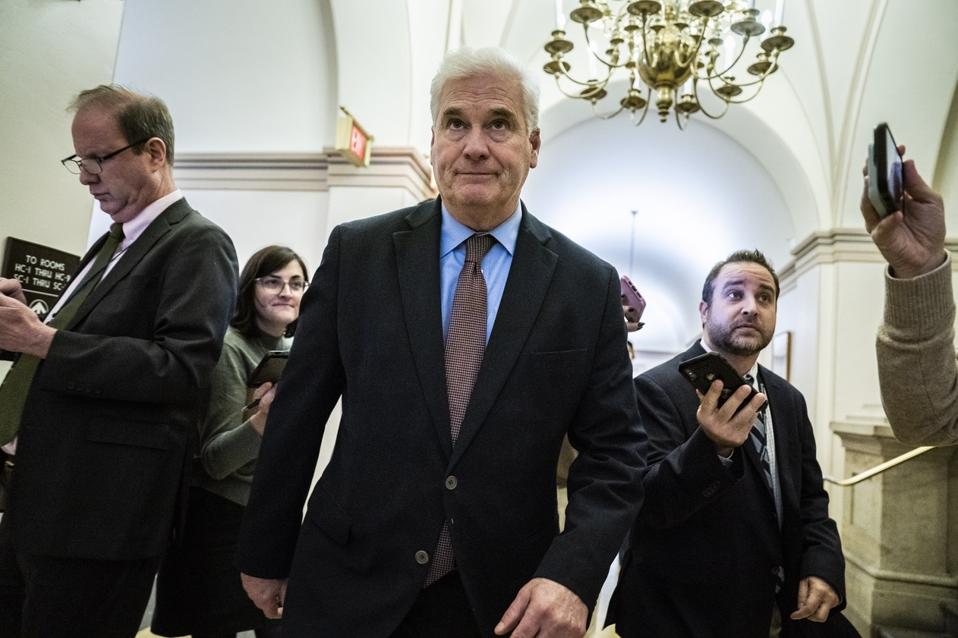
Rep. Tom Emmer (R-Minn.) is considered a front-runner in the speaker race after earning an endorsement from former speaker Rep. Kevin McCarthy (R-Calif.), but he faces an uphill battle for support from former President Donald Trump’s allies in Congress—here’s what to know about Emmer as the House votes again this week to select a new speaker.
Key Facts
Emmer, who announced Saturday he would run for the position, has so far secured more public endorsements from his Republican colleagues than any of the eight other candidates, with McCarthy telling NBC’s Meet the Press on Sunday that Emmer is “head and shoulders above all those others who want to run,” while touting his work on key GOP legislation, including border security bills and the Parents Bill of Rights that requires public schools to provide more information to parents about what goes on in their children’s schools.
Emmer—elected to the House in 2015 to represent a district in suburban northwest Minneapolis after six years in the Minnesota House of Representatives—is Majority Whip, the No. 3 GOP position in Congress, and he previously served two terms as chairman of the National Republican Congressional Committee, fundraising for Republican candidates and campaigning on their behalf to help Republicans take back the majority in Congress in the 2022 midterm election.
While Emmer is well-respected among Republicans in Congress, the Trump-aligned faction of the party could block him from winning the 217 votes he needs to become speaker as he can afford to lose only four GOP votes, assuming all Democrats continue voting for Minority Leader Rep. Hakeem Jeffries (D-N.Y.).
The Minnesota Congressman is one of only two GOP candidates for speaker, along with Rep. Austin Scott (R-Ga.), who voted to certify the results of the 2020 presidential election, and he sharply rebuked the January 6 Capitol riots, positions that have put him at odds with Trump, who has reportedly been urging Republicans not to elect Emmer in private.
Emmer is arguably the most moderate of the nine candidates—he was the only one who voted in favor of legislation to federally recognize same sex marriage last year, he supports aid for Ukraine and he voted alongside Democrats and a handful of Republicans in September for the short-term budget to avert a government shutdown.
Emmer, 62, an attorney, father of seven and former college hockey player-turned youth coach in Minnesota, often references the sport as an example of his negotiating skills—he recounted how he had to ingratiate himself into the politics of local youth hockey to improve the program he started in the 1990s, telling Fox: “I recognized you’ve got all these competing entities, much like you have in Congress.”
While serving in the Minnesota House of Representatives, Emmer ran for governor and received an endorsement from former Alaska Gov. Sarah Palin (R), but he lost the contest by less than a one point margin.
Crucial Quote
“Our Conference remains at a crossroads and the deck is stacked against us,” Emmer wrote in a letter to Republicans announcing his speaker candidacy. “We have no choice but to fight like hell to hold on to our House Majority and deliver on our conservative agenda.”
Tangent
GOP Reps. Mike Johnson (La.), Byron Donalds (Fla.), Kevin Hern (Okla.), Jack Bergman (Minn.), Scott, Pete Sessions (Texas), Gary Palmer (Ala.) and Dan Meuser (Pa.) are also running for speaker.
Chief Critic
Trump and his allies have reportedly taken issue with Emmer’s absence of an endorsement for Trump’s 2024 presidential campaign, according to Politico, which also reported Rep. Jim Banks (R-Ind.) fueled tensions between Emmer and Trump’s orbit when the two ran against each other for whip last year. Trump and his allies have also accused Emmer of encouraging some GOP candidates to distance themselves from Trump during the 2022 election, Politico reported, though Emmer denied the allegation in an interview with Fox last year, telling the network Trump has been a “fantastic ally” for Republicans. But he added that candidates should “know [their] districts,” a subtle warning that candidates in swing districts should be wary of aligning themselves with Trump.
Key Background
The House is approaching three weeks without a speaker after McCarthy became the first speaker in history to be ousted from the job in a right-wing revolt on October 3, and the party has failed to coalesce behind a replacement candidate. The GOP’s narrow majority in the House means that the winning candidate can afford to lose no more than four Republican votes, and a small coalition of far-right members threaten to block any speaker who does not align with their ideological faction by voting for alternative candidates. Republicans voted to remove their previous nominee, far-right firebrand Rep. Jim Jordan (Ohio), when he lost three consecutive rounds of the speaker election last week, re-opening the race. The GOP is expected to vote on a new nominee this week and hold a formal election with the entire House, which has been frozen in a legislative stalemate without a speaker to control which bills come to the floor.
Further Reading
Meet The GOP Speaker Frontrunners—Emmer, Hern, Donalds And Scott—After Jordan Exits Race (Forbes)
Jordan Is Out: Secret Vote Ousts Him As Speaker Designate After Third Loss (Forbes)
Jordan Loses Third Round Of Speaker Voting As McCarthy Says ‘We’re In A Very Bad Place Right Now’ (Forbes)