

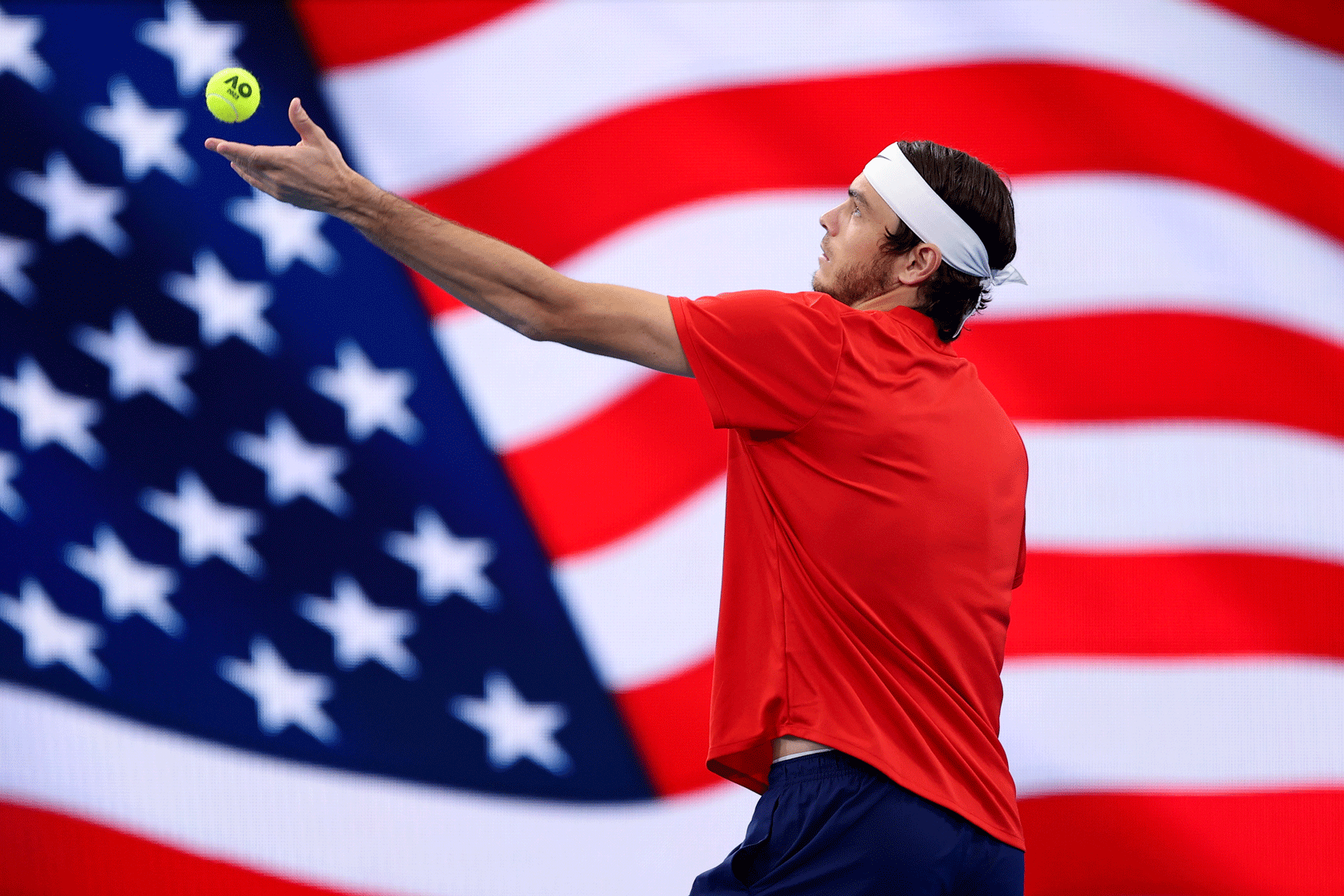
Thanks to the Williams sisters, the U.S. women’s game has built a steady flow of young talent. But the men haven’t served up a Grand Slam winner in two decades. That could soon change thanks to players like Frances Tiafoe, Taylor Fritz, Tommy Paul and other future kings of the court.
“I feel like I let you guys down,” Frances Tiafoe told a sold-out crowd inside Arthur Ashe Stadium after losing a five-set thriller in last year’s U.S. Open semifinals. “I will come back and win this thing one day—I’m sorry, guys.”
Tiafoe’s run, the deepest for an American in any tennis major since 2006, stirred the echoes of Andy Roddick’s U.S. Open victory in 2003—the last time an American man won a Grand Slam singles title—and fed fans’ desire to once again anoint a star in the sport. The match became part of the most-watched semifinal day of any Grand Slam event in ESPN history, and in the months after, the 25-year-old Tiafoe signed sponsorship deals with mainstream brands such as Cadillac, Barclays, Stella Artois and CLIF Bar and shot a new commercial for Beats By Dre—an impressive list for a player ranked No. 10 with just two career ATP titles.
“I don’t think I’ve seen where someone with a semifinal at a U.S. Open came out of it with the number of partners that he has and the level of partners that he has,” says Tiafoe’s agent Jill Smoller, who counts Serena Williams as a longtime client.
In the past 12 months, Forbes estimates Tiafoe has earned $6 million off the court from sponsorships and appearance fees for tournaments and exhibition events, plus another $3.4 million in tournament winnings. And he’s not the only American with outsized earnings. Taylor Fritz, also 25 and ranked No. 9 in the world, brought in an estimated $5 million off the court despite just one quarterfinal appearance in a Grand Slam, to go with $4.7 million in prize money.
Both Tiafoe and Fritz landed just outside Forbes’ list of the ten highest-paid tennis players in the world, edged out by two American women—Coco Gauff and Jessica Pegula— who also have yet to win a Grand Slam.
“If you’re a star in the U.S., no doubt, you have a higher earning potential,” says John Tobias, executive vice president of GSE Worldwide, an agency that represents several top players, including Pegula. “Frances broke through, he had that big win against [Rafael] Nadal on a big stage, but he didn’t win the tournament. So what is the American public thinking—what’s that next big step? It’s for him to win a tournament, a big one, and in tennis we’ve got four a year that everyone’s shooting for.”
By almost any measure, this has been the best year for American men’s tennis in more than a decade. At the Australian Open in January, three U.S. players made it to the quarterfinals of a major championship for the first time since 2005, and Tommy Paul was the first semifinalist Down Under since 2009. And in July, Chris Eubanks came one set shy of earning his own semifinal berth at Wimbledon.
At one point this year, there were ten Americans ranked in the top 50 in the world, another feat that hadn’t been accomplished in more than 20 years. The United States still represents the most players in the top ten (two, tied with Russia), top 50 (eight), and top 100 (11, tied with France) heading into this year’s U.S. Open.
Still, American fans expect championships, like the ones produced by John McEnroe and Jimmy Connors in the 1980s and Pete Sampras, Andre Agassi and Jim Courier in the 1990s and early 2000s. Those Tennis Hall of Famers were Grand Slam champions as well as some of the most recognizable faces in the world, with Sampras and Agassi appearing regularly on Forbes’ list of the highest-paid athletes and entertainers in the world for a decade.
In the women’s game, U.S. fans have been spoiled for some 25 years by the extraordinary careers of Venus and Serena Williams. But American men—like players from almost every country—have played in the shadow of Roger Federer, Nadal, Novak Djokovic and Andy Murray for the past two decades. After Roddick retired in 2012, the pipeline of American players was severely lacking, and the United States Tennis Association realized it needed to drastically change its process if it hoped to regain its former glory.
“The consensus from the board was that we were really falling behind,” says Martin Blackmon, the USTA’s general manager of player development. “We needed to step into that space and partner with the private sector to bring more resources and more world-class expertise.”
A decision was made to allocate more funding from the USTA’s budget toward junior player development—spending in that category increased from $10.4 million in 2007 to $15.6 million by 2010. Staffing also increased, and a nationwide system of camps was implemented on a sectional, regional and national level to identify and develop the nation’s most promising players.
One of the earliest classes of talent to emerge included Tiafoe from the mid-Atlantic region, Fritz from Southern California, Paul from Florida, and Reilly Opelka from the South, all of whom began competing against one another in their early teens at national camps. By age 16, Paul and Opelka were training full time at the USTA campus in Boca Raton, Florida, and Fritz was full time with the USTA in Carson, California.
By 2015, they were among the best juniors in the world. That year, Paul won the French Open juniors title over Fritz in the final. Opelka won the Wimbledon juniors tournament, and Fritz won the U.S. Open juniors over Paul. Tiafoe, meanwhile, claimed the USTA Junior National Championship and became the first 17-year-old American to play in the main draw of the U.S. Open since Sampras and Michael Chang.
Fritz, Tiafoe and Paul now rank in the top 15, and Opelka climbed as high as No. 17 last year before being sidelined with a hip injury. And there’s now an army of twentysomething American players—including Sebastian Korda, Ben Shelton, Mackenzie McDonald and J.J. Wolf in the top 50. Together, they’ve been able to share the title of the “Next Great American Hope,” a moniker that has proved too weighty for any one player to handle since Roddick made his last Grand Slam final appearance at Wimbledon in 2009.
“It’s tons of pressure,” says James Blake, a retired American player who peaked at No. 4 in 2006. “I think Andy felt it for a long time, I felt it, and I think these guys, especially as they get later in Slams, they’ll start hearing it more and more. That’s where I think it’s huge that they have a stable because if it was just one—let’s say it was just Taylor [Fritz], and he was top five in the world but consistently losing in quarters and semis in Slams and not getting over that finish line—he would hear it so much.”
That’s not to say there isn’t competition among the young Americans. The overwhelming consensus among those on the business side of the sport is that a higher level of mainstream superstardom, and the sponsorship dollars that come with it, is reserved for the one player who can end the Grand Slam championship drought.
“Whichever American male wins that Slam, it’s going to completely change his landscape forever,” says James Beres, an agent at Topnotch Management, who works with Opelka as well as other top Americans John Isner and Wolf. “Every agent who works with an American male player wants their player to be the first one to do it because their stardom is going to completely take off.”
While success will bring fame and fortune, Blake is quick to point out that it’s up to that player to capitalize on it in order to break through the crowded American sports landscape and become a household name. He remembers the whirlwind Roddick went through after his triumph in 2003, hosting Saturday Night Live and appearing on late night talk shows with Conan O’Brien and David Letterman. “He was able to sustain it because of his personality,” Blake says. “He was dynamic, thoughtful and—don’t ever tell him I said this but—good looking, so he had a lot going for him.”
This new crop of Americans is similarly well positioned. Tiafoe’s story, in particular, is irresistible—he is the son of immigrants from Sierra Leone and grew up living part time in the spare room of a public tennis facility where his father worked. Fritz carries the looks and demeanor of a Southern California surfer. Korda’s father, Petr, won the 1998 Australian Open, and his sister, Nelly, has been the No. 1 golfer in the world.
Shelton, the youngest of the group at age 20, is already a star on social media. Last year, he says, he could walk around the grounds of the U.S. Open unnoticed. But after a quarterfinal appearance at the Australian Open and enough wins to rank him inside the top 40, he expects a different experience this time around as fans hope he can make a deep run.
“There’s a lot of hype around the tournament,” Shelton says. “I’m sure we all have goals to be No. 1 in the world or win a Grand Slam. That’s what America is always looking for—they want to know who is going to be the next champion.”