

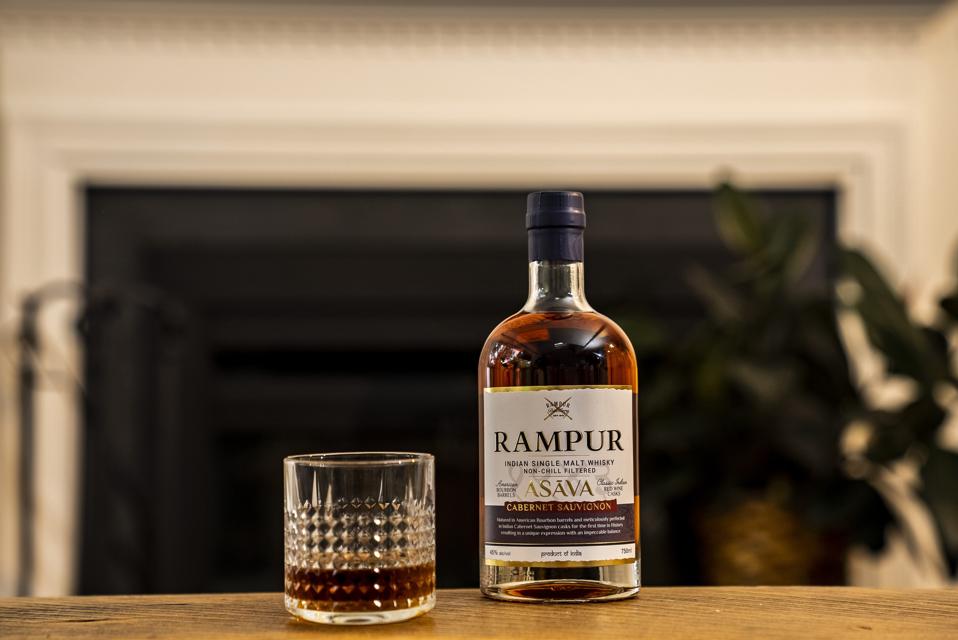
India produces nearly 50 percent of all the whisky in the world, but most of it stays within its borders.
The folks at Rampur Distillery want to change that, and they especially want scotch and American Single Malt drinkers to give try Indian whisky.
“India produces some 48 percent of all whisky in the world,” says Sanjeev Banga, president of international business of Radico Khaitan, the parent company of Rampur Distillery. “Most of their stock stays within India’s borders, but thanks to some producers like us, our wonderful whisky has gradually made its way to the United States and elsewhere. There are only a handful of Indian whiskies in the United States, with Rampur being one of the most highly regarded.”
Rampur Distillery was founded in 1943. “But Rampur, as a brand, had its genesis in 2015,” Banga says. “In November of this year, the master blender offered the management team some of his newest, matured malt to sample, and those decision makers were so impressed that within 15 minutes of tasting, it was decided to bottle it.”
The whisky, Rampur Select, was released five months later at a spirits show in Las Vegas. “It sold out very quickly, and it was only just re-released earlier this year,” Banga says, of the spirit, which retails for $140.
This success led to the development of Rampur Double Cask ($79.99) and Rampur Asava ($89.99). “Rampur Asava has garnered countless international accolades, and it has found itself on several top whisky lists,” he says.
Indian whisky, especially Indian Single Malt, has a different aging process.”An exceptionally unique characteristic of Indian Single Malt production is that the aging process occurs in a much more condensed period of time than it does in other parts of the world,” Banga says.
The climate in northern India has dramatic temperature swings, from 108º Fahrenheit in the summer, dropping down to 35º Fahrenheit in the winter. “The malt interacts very aggressively with the cask, and maturation is almost four times faster than Scotland,” he says. “Even though heavy evaporation losses make it a very expensive proposition to mature malt for an extended period of time, the unique flavor it imparts to the malt more than compensates these losses.”
The Rampur Indian Single Malt Collection is made from 100% 6 row Indian barley, and the maturation facility, located in the foothills of the Himalayas in Uttar Pradesh, is uniquely suited to the aging of malt spirits due to the extreme seasonal shifts in climate, Banga says. “This allows for Rampur’s singular flavor profile, achieved at a much faster pace than, say, Scotland,” he says. “Just as the notes expressed in any well-made spirit should give voice to the place from which it hails, Rampur Indian Single Malt is imbued with notes of honey, golden plum, even pineapple, bursting with life like an Indian summer.”
This collection of single malts is distributed throughout the United States, and “it can be found in some of the top restaurants in cities up and down each coast,” Banga says.
Later this year, Rampur will be releasing a World Malt Whisky called Sangam. “We are constantly innovating and adding additional products to our collection,” Banga says. “We represent the flavors of India and take inspiration for the tastes and nuances of Indian culture.”